Securitize expanded its Tokenized AAA CLO Fund, STAC, to Solana this week, with Ethena Labs planning a $250 million allocation. The fund gives eligible investors tokenized exposure to U.S. dollar AAA-rated collateralized loan obligation tranches, with BNY serving as custodian and sub-adviser. For Ethena, the allocation would add regulated structured credit to the reserve mix behind USDe, linking DeFi-native stablecoin infrastructure with institutional RWA collateral. In this issue, we cover what STAC is, why Solana matters for the deployment, and what Ethena is trying to solve by adding AAA CLO exposure.
What STAC brings onchain
STAC is a tokenized fund focused on AAA-rated collateralized loan obligation tranches, sourced from primary and secondary markets. Securitize says the strategy does not use leverage and is built around floating-rate structured credit, which means returns adjust with market rates rather than being locked into a fixed coupon.
That matters because the addressable market is large. Securitize cited Bank of America Global Research data showing global CLO issuance above $1.3 trillion as of September 2024. Bringing even a small slice of that market onchain gives protocols another form of productive collateral beyond Treasuries, stablecoins, and crypto basis trades.
The institutional wrapper is also important. STAC was developed with BNY, which serves as custodian of the underlying assets and sub-adviser through BNY Investments. Investors subscribe through Securitize’s regulated platform, with KYC, AML, accreditation checks, transfer-agent infrastructure, and onchain ownership records.
Why Ethena is interested
Ethena’s planned $250 million allocation is best read as reserve diversification. USDe has grown around crypto-native collateral and derivatives-based hedging, but the protocol has been adding more institutional credit exposure to reduce dependence on one return source. STAC gives Ethena access to AAA CLO exposure through a tokenized security rather than a traditional offchain fund position.
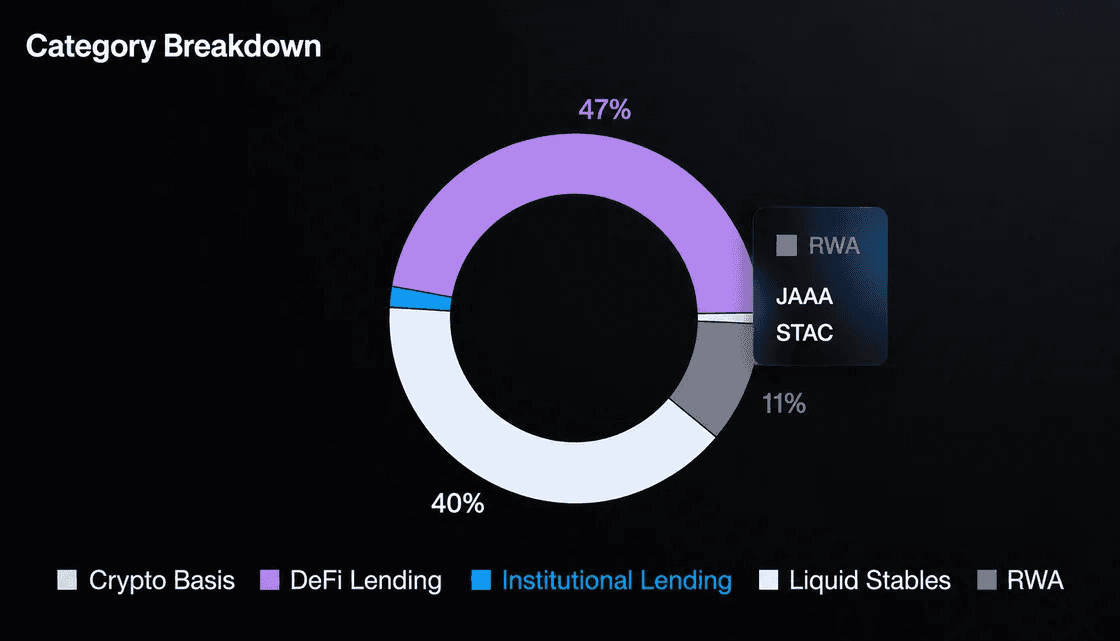
The timing also fits Ethena’s broader June activity. Governance discussions around STAC and JAAA treated tokenized CLO exposure as one shared asset-class bucket, not as unrelated positions. The core questions were liquidity, credit quality, drawdown behavior, and pricing transparency. AAA defines a more conservative part of the structured-credit stack. Ethena's backings so far are composed by 11% of RWAs:
Why Solana is the venue
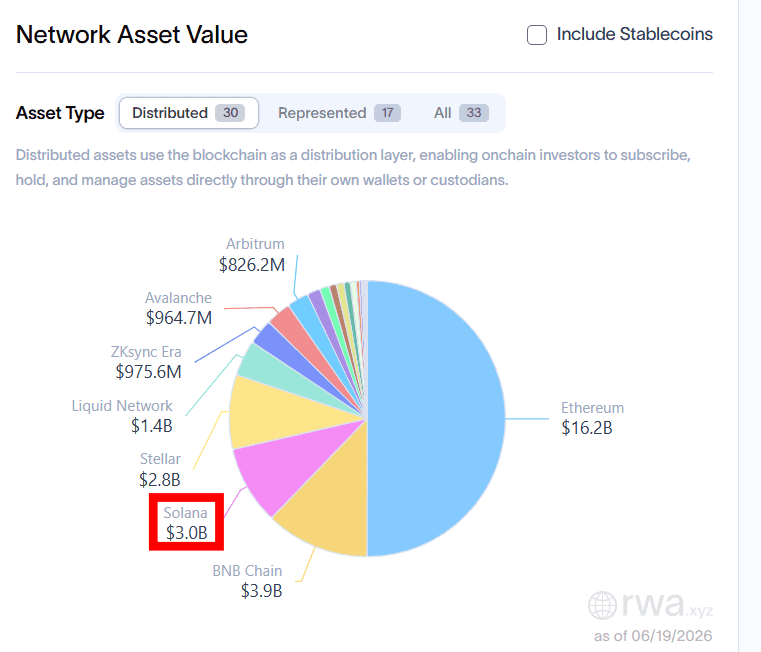
For Solana, the announcement adds another regulated RWA product to a network that has been competing for institutional issuance. Securitize said assets tokenized on Solana through its platform increased about 75% over the prior 30 days before including Ethena’s planned allocation. Solana stands at 3.0B in distributed RWA value and 4.40B in 30-day RWA transfer volume as of June 19, scoring 3rd after Ethereum and BNB Chain.
The chain selection is not only about fees. Low-cost settlement helps, but the more relevant test is whether regulated issuers and DeFi protocols can coordinate identity, transfer restrictions, custody, and collateral use without forcing investors back into manual offchain workflows. STAC moving to Solana is a signal that tokenized credit is starting to look multi-chain by default.
The bigger takeaway
The STAC launch is about collateral design. DeFi-native dollars need reserve assets that can scale, settle efficiently, and survive institutional diligence. Tokenized AAA CLOs will not replace Treasuries, but they add a different yield profile and a deeper credit market to the collateral menu. For Solana, the question is whether this becomes repeat issuance or remains a headline allocation. For Ethena, the question is whether structured credit improves reserve resilience without adding hidden liquidity risk. Not financial advice.