
This week’s focus is Morpho Midnight, Morpho’s newly launched fixed-rate, fixed-term lending protocol. We examine its initial adoption, the mechanics behind its offer-based model, how it differs from Morpho Blue and earlier fixed-rate designs, and the risks that will determine whether Midnight can develop into meaningful onchain credit infrastructure.
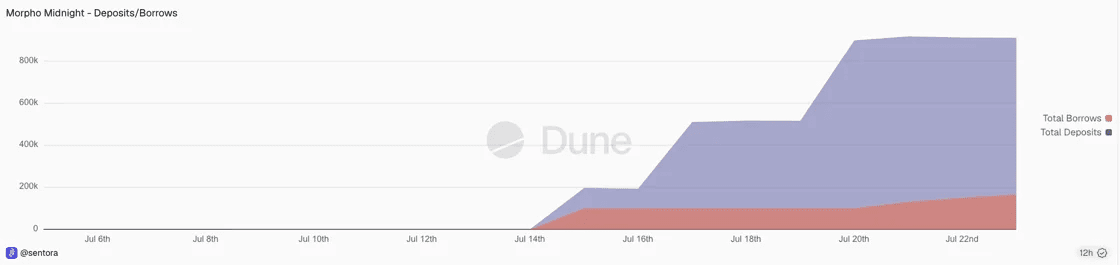
Morpho publicly launched Midnight on Base on July 21, introducing its first production system for loans with predefined rates and maturities. At the time of writing, the protocol has approximately $908,000 in TVL and $152,000 in active loans, implying that roughly 17% of deposited collateral currently supports outstanding debt. These figures remain small relative to Morpho Blue’s multibillion-dollar footprint, but they provide the first observable data for a protocol that had previously operated in beta.
The launch expands Morpho beyond its established variable-rate lending model. Morpho Blue currently holds approximately $7.5 billion in TVL, while Morpho’s wider network reportedly supports more than $11 billion in deposits across products and integrations. Midnight is therefore not launching as an isolated startup protocol: it enters the market with access to Morpho’s existing curators, integrators and liquidity relationships.
Source: Dune
Midnight differs from Morpho Blue by offering fixed-rate, fixed-maturity loans instead of open-ended borrowing with utilization-driven rates. A lender provides assets today in exchange for a larger predefined amount at maturity, allowing both sides to know the financing terms in advance.The protocol uses signed maker offers rather than requiring liquidity to sit idle in every maturity market. Makers specify the rate, size, maturity and validity period, while borrowers execute available offers through routers or RFQ systems.
This structure helps reduce liquidity fragmentation. Makers can quote across several markets using shared exposure limits, while callbacks allow capital to remain deployed elsewhere such as in Morpho Blue until an offer is filled.
However, quoted liquidity may not always be immediately executable because funds are not necessarily reserved when an offer is signed. Execution can depend on the maker’s available balance, callback conditions and the router’s ability to source the best valid offer.
Midnight also supports multi-collateral positions. Markets can include several approved collateral assets, each with its own LLTV, oracle and liquidation parameters. This may be attractive for institutions, DAO treasuries and tokenized asset portfolios that want to borrow against a diversified collateral base.
For lenders, this flexibility creates an important risk: exposure is determined by the full collateral set permitted by the market, not only by the assets currently deposited. Users therefore need to assess the weakest collateral asset, oracle and liquidation route available within each market.
Key indicators to monitor include:
Growth in outstanding borrows rather than collateral deposits alone.
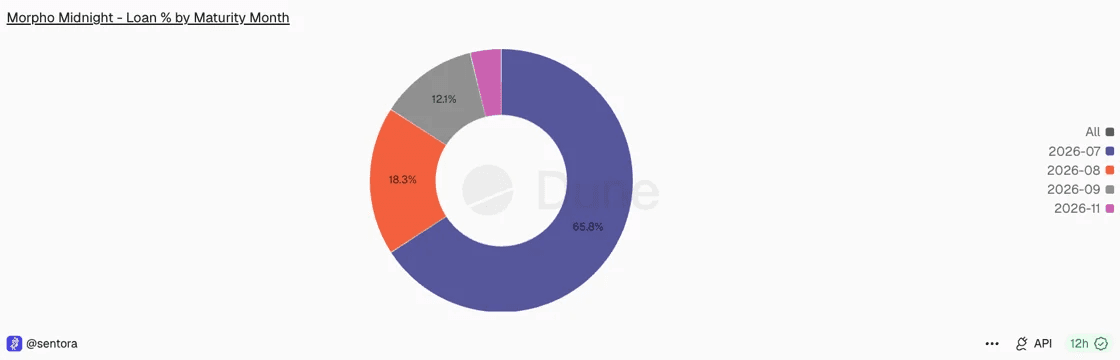
Borrowing activity across different maturities.
Available liquidity and bid-offer spreads.
Dependence on incentives or professional market makers.
Collateral concentration and liquidation liquidity.
Source: Dune
The key takeaway is that Midnight gives Morpho a fixed-rate credit layer alongside Morpho Blue’s variable-rate markets. Its offer-based model improves capital efficiency, but adoption remains early and sustainable growth will depend on recurring borrower demand and reliable execution liquidity.