Most capital locked in DeFi protocols is organised around three large pools. Lending markets supply onchain credit, decentralised exchanges provide the liquidity that lets assets trade, and liquid staking converts staked assets into tokens that can be reused elsewhere in the system.
Across all three, the bulk of the capital has settled with a small group of protocols, and that group's share has been rising.
This article examines how far that consolidation has gone and which direction it is moving, drawing on protocol-level figures for how much each category's largest names control. The usual way to express the measure is dominance, meaning the proportion of a category held by its leading protocols. The reading is consistent across the three categories: it grew stronger through the most recent downturn, and it echoes the way traditional markets tend to consolidate as they mature.
How Concentrated Is DeFi, Really?
The clearest way to see the pattern is to set the three categories side by side.
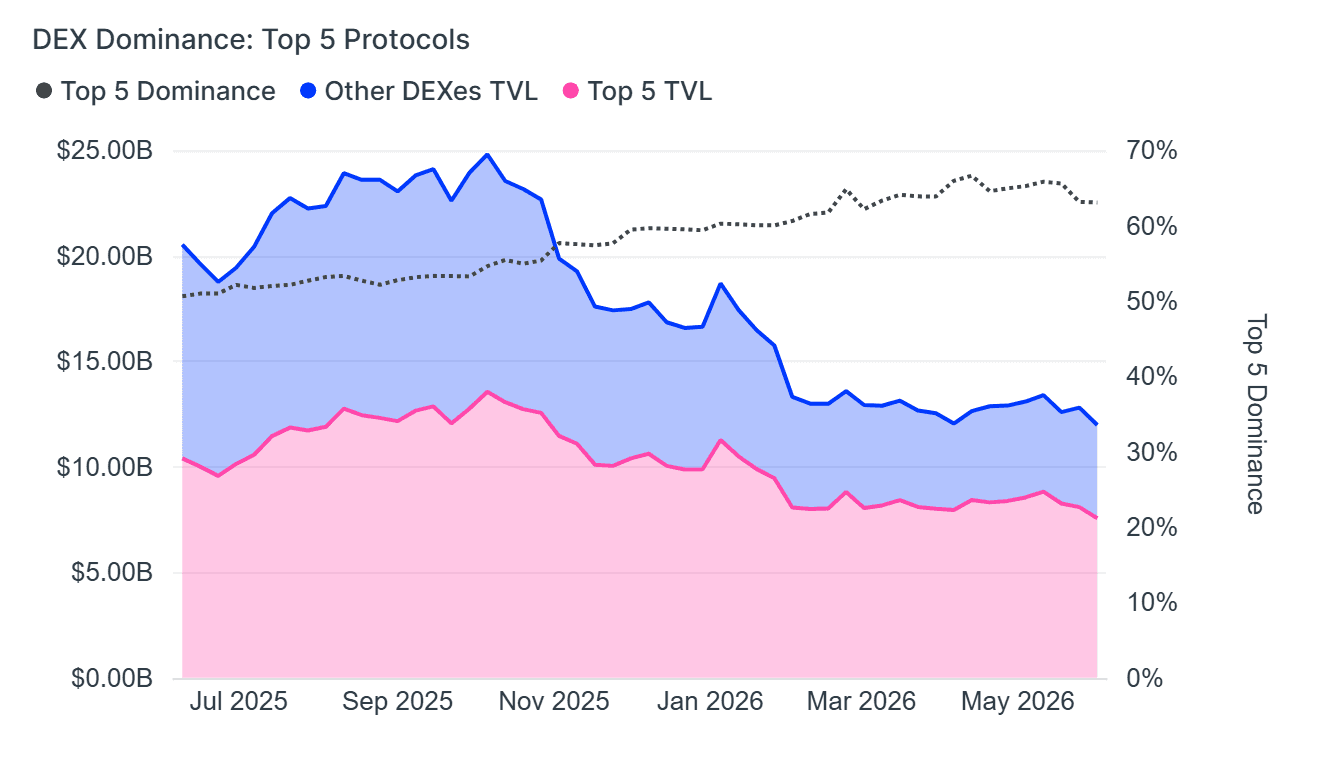
The five largest lending protocols attract close to three quarters of all lending capital between them. In liquid staking, depositors concentrate even further, with the top five drawing slightly more than three quarters of the category. Decentralised exchanges are the most fragmented of the three, yet the top five still capture more than 60% of capital deployed.
Category | Top-five dominance | Largest protocol | Category total |
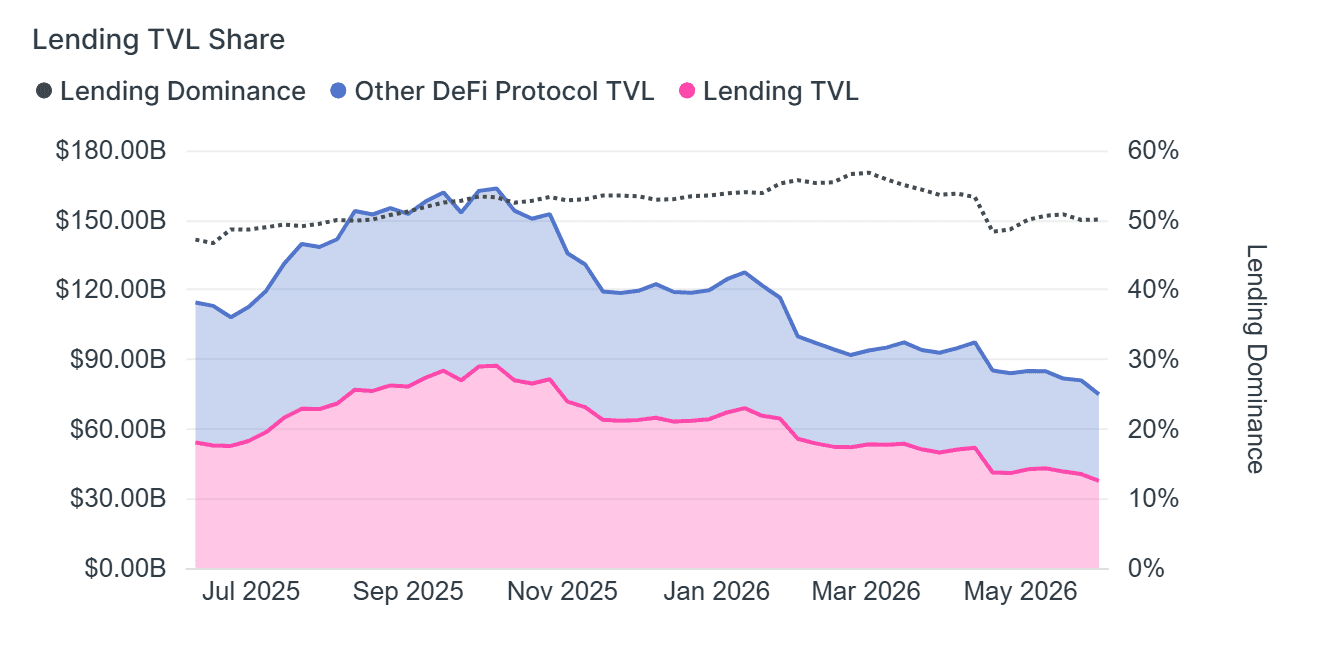
Lending | ~73% | Aave, 32.78% | About $36.5B |
Liquid staking | ~76% | Lido, 47.47% | About $31.0B |
Decentralised exchange | ~62% | Uniswap, 24.19% | About $11.6B |
Additionally, every category has one clear leader, a meaningful second, and a steep drop into a tail of smaller venues, which means the bulk of each category rests on its first one or two names.
The Leaders Carry Most of the Weight
The single-name figures sharpen the picture further. 32.78% of all lending capital sits with Aave depositors. In liquid staking, 47.47% sits with Lido stakers, close to half the category on its own. In decentralised exchanges, 24.19% routes through Uniswap, across a category split across several chains where it competes directly on only some of them.
Each of these categories is defined by a dominant protocol that sets the terms, a second large enough to matter, and a long tail that together holds less than the leader does, so the health of each category is closely tied to the health of its largest one or two participants.
You can explore the DeFi capital concentration in depth on Sentora's Crypto Dominance dashboard.
Lending Holds Steady at the Base
Lending is both the largest category and the most stable, holding roughly half of all DeFi capital and staying near that level across market cycles.
Its stability comes from its function, because lending underwrites leverage, hedging, working capital, and a range of yield strategies; and demand for credit persists whether prices are rising or falling. Traders borrow to add leverage in a rally and to hedge in a decline, so the category that supplies that credit stays full through both.
The other categories are smaller and more sensitive to fluctuating market conditions.
Liquid staking moves with the value of the assets being staked, which falls in a downturn even when the quantity staked holds steady.
Decentralised exchanges depend on trading activity and on the value of the assets sitting in its pools.
Both respond to the market more readily than lending does, which leaves the base of the stack as the part that holds firmest when the rest gives way.
Concentration Rose as the Market Fell
The strongest evidence that concentration is increasing comes from the most recent contraction. Total value across all three categories reached its high in 2025 and declined over the months that followed as capital flowed out of the market.
Dominance, however, held steady or climbed even as the totals fell, because the capital that left did not leave evenly. It withdrew from the smaller venues first and gathered in the largest, so the market contracted and concentrated in the same motion.
Concentration across DeFi is already high, and it rose while the market fell, which means the pull toward the largest venues was strongest at the moment capital was most cautious.
Concentration Can Climb Through Attrition
Part of the reason dominance rises in a downturn has nothing to do with new deposits arriving at the leaders.
In a category headed by one large name, a decline in total value rarely strikes the leader hardest, because the leader holds the deepest liquidity and the widest integration, which are the last things capital abandons.
The smaller protocols in the tail hold neither advantage, so they lose capital first and fastest. A falling market therefore thins the tail while the top holds, and the leader's share rises simply because the rest of the category shrank around it.
In other words, concentration can increase through attrition alone, which is one reason it tends to climb precisely when conditions are at their worst.
A Pattern Familiar From Traditional Markets
This behaviour is not unique to DeFi, since markets tend to concentrate as they mature and to concentrate hardest under stress.
Bank deposits have gathered steadily in the largest institutions, a trend that accelerated after the 2008 crisis as depositors and regulators alike came to favour scale. A small group of asset managers now holds a controlling share of index-fund ownership across listed companies.
During the money-market panic of March 2020, capital fled smaller funds for the largest and most liquid within a matter of days.
In each case, participants who wanted safety moved toward size, because size carries depth, a track record, and an assumption of resilience. DeFi has now grown large enough and old enough to display the same instinct in full, and regulators eventually formalised the pattern elsewhere by designating the largest banks as systemically important.
The Real-Time Advantage of Onchain Markets
What separates onchain, decentralised markets from its traditional counterpart is immediacy in visibility.
Simply put, traditional concentration is reported quarterly and in aggregate, well after the fact, whereas onchain concentration can be observed and tracked continuously and at the level of individual protocols, with the share each venue holds and the direction it is moving, readable directly from the chain.
That visibility allows concentration to be treated as a live signal, because a market participant can watch the weight gather in real time and see which way it is shifting before the totals settle.
The DeFi Concentration Trend
Capital across DeFi is consolidating into its largest venues, and the trend accelerates whenever the market falls.
This makes the concentration of a category as important as the choice of protocol within it, because a deposit placed in a thin venue inside a category that a few names control carries the structure of that category alongside the terms of the venue itself.
Since the size and direction of that concentration can be read directly from onchain data, it becomes something an allocator can monitor and act on rather than a condition discovered only in hindsight.
About the data. Every figure in this article is drawn from the Sentora Crypto Dominance Dashboard, which tracks the top five protocols across lending, decentralised exchanges, and liquid staking, alongside each category's share of total DeFi TVL. The dataset is maintained by Sentora Research and refreshed regularly.