
Bitcoin ETFs Meet Tactical Institutional Capital
May erased April’s ETF momentum
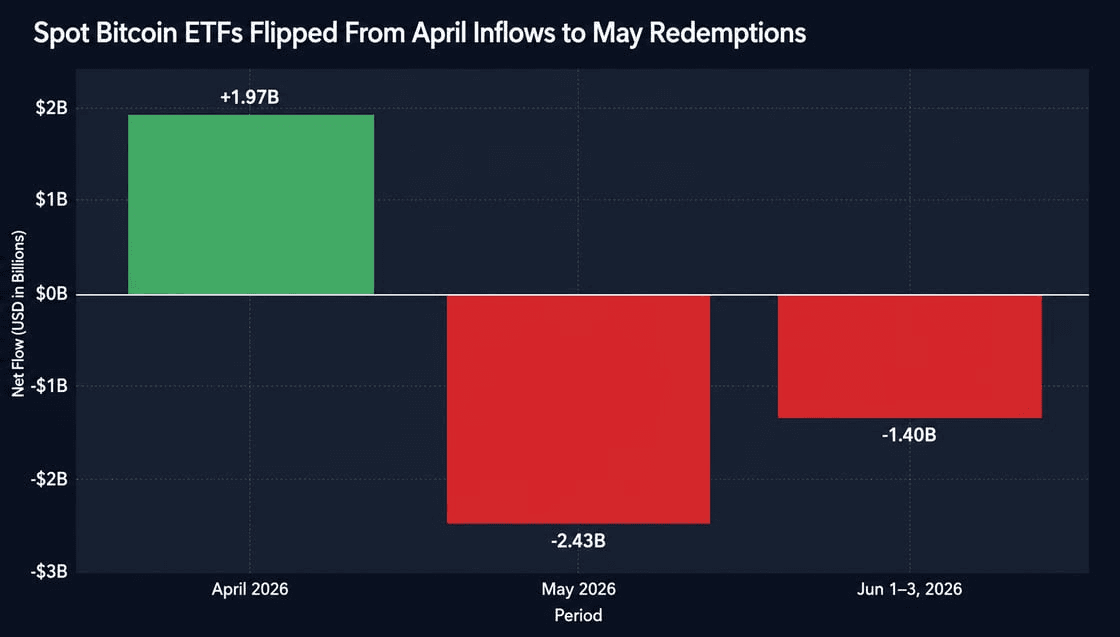
US spot Bitcoin ETFs closed May with roughly $2.43B in net outflows, the weakest monthly print of 2026 and a hard reversal from April’s $1.97B in net inflows. That swing matters because April had restored confidence that regulated vehicles were again becoming a persistent source of demand after a softer start to the year.
The reversal was not a one-day anomaly. Daily flow for May sum to approximately -$2.43B, with the damage concentrated in the second half of the month. Only 6 of 20 May trading sessions recorded positive flows, while the final stretch was dominated by broad redemptions across the complex.
Source: SoSoValue
The month started with strength: May 1, May 4, and May 5 brought in a combined $1.63B. By mid-month, the tone had changed. May 13 printed -$635M, May 15 started the persistent outflow streak, and the final week delivered the cleanest evidence that institutional capital had shifted from accumulation to de-risking.
The flow tape became the market tape
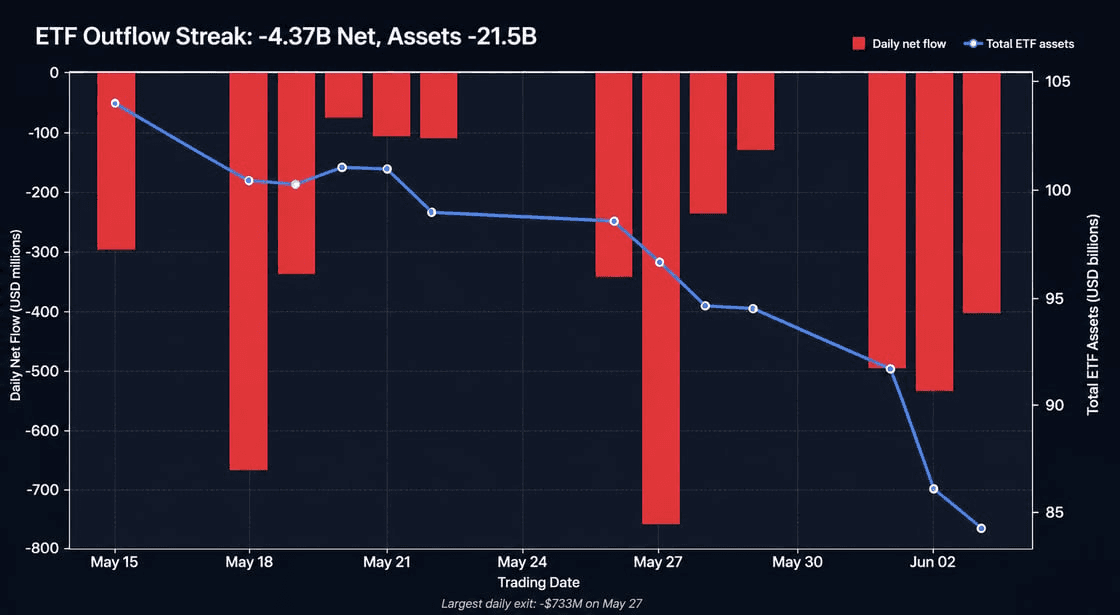
From May 15 through June 3, US spot Bitcoin ETFs saw about $4.37B in cumulative outflows. Total ETF assets fell from $104.29B to $82.83B over the same window, reflecting both redemptions and Bitcoin’s spot-price drawdown.
Source: SoSoValue
The largest daily exit was -$733M on May 27, followed by continued redemptions of -$229M on May 28, -$125M on May 29, -$484M on June 1, -$519M on June 2, and -$397M on June 3. For a market that had become used to ETF creations acting as a steady bid, the mechanical implication was straightforward: redemptions forced the ETF complex from marginal buyer into marginal seller.
That is why the ETF flow tape now matters more than most short-term on-chain metrics. When ETFs receive inflows, issuers and authorized participants support spot demand. When ETFs redeem, that support reverses. The daily print has become a high-signal indicator for institutional risk appetite because it converts macro positioning into observable spot-market pressure.
IBIT was the stress gauge
BlackRock’s IBIT remains the bellwether because it is the largest, deepest, and most institutionally legible wrapper for spot Bitcoin exposure. On May 28, IBIT recorded $527.84M in net outflows, its second-largest single-day withdrawal since launch and just below the January 30 record of $528.3M.
CoinDesk reported that the broader US spot Bitcoin ETF complex lost $733.43M around that same late-May stress point, with Fidelity’s FBTC and Grayscale’s GBTC also contributing to the drawdown. A reported $1.29B dark-pool block sale in IBIT the day before reinforced the read that large allocators were actively trimming exposure rather than passively waiting out volatility.
The nuance is important: this is not proof that institutions have abandoned Bitcoin. It is proof that ETF capital is highly tactical. These vehicles are liquid, easy to rebalance, and embedded in portfolio-management systems that respond quickly to volatility, rates, and cross-asset opportunity costs.
Macro drove the rotation
The redemption wave lined up with a classic risk-off setup: elevated Treasury yields, sticky inflation concerns, reduced confidence in near-term rate cuts, geopolitical tension, and a stronger preference for assets with earnings momentum or explicit yield. Bitcoin, despite its institutionalization, remains a zero-coupon, high-volatility asset in most allocator models.
That distinction matters for how to interpret the outflows. A structural rejection would look like persistent product-specific impairment, widening discounts, custody concerns, or a collapse in cumulative demand. Instead, cumulative ETF inflows since launch remained around the high-$50B range even after the drawdown, while the selling clustered around a macro rotation.
In other words, the ETF complex is behaving like an institutional instrument. It absorbs capital when the macro backdrop supports risk-taking and releases capital when portfolio managers need to reduce volatility. That makes Bitcoin more accessible, but it also makes it more sensitive to the same cross-asset allocation rules that govern equities, credit, and commodities.
What to monitor into next week
The most important signal is whether the daily ETF print stabilizes before price does. A single green day after a long outflow streak is not enough by itself, but a sequence of smaller redemptions or renewed creations would indicate that forced de-risking is losing intensity.
For DeFi and crypto-native allocators, the watchlist should be practical:
IBIT daily flows: the cleanest read on large institutional risk appetite.
Total ETF assets: useful for separating flow pressure from price-driven asset declines.
BTC spot support around the recent drawdown zone: ETF redemptions matter most when liquidity is thin and leverage is being reduced.
Perpetual funding rates: delta-neutral yield depends on whether funding remains positive after the spot market reprices.
Stablecoin supply and lending rates: capital rotating out of beta may first land in cash-like instruments before moving into structured yield.
The key takeaway is that spot Bitcoin ETFs have made institutional demand visible, but also more cyclical. May’s $2.43B outflow shows that regulated capital can rotate out of pure beta quickly when macro conditions deteriorate, even if long-term adoption remains intact.
Headless DeFi and the Shift to Agentic Engineering
The era of clicking through web frontends is ending for institutional power users and automated workflows. Web3 UIs, plagued by wallet-connect modals, dynamic React components, and RPC latency, are fundamentally hostile to automation. As the industry transitions from loose "vibe coding" (asking a chatbot to generate a script and hoping it works) to deterministic agentic engineering, protocols are actively discarding graphical interfaces in favor of the terminal.
By releasing dedicated Command Line Interfaces (CLIs) and Model Context Protocol (MCP) servers, major DeFi platforms are shipping "Agent Skills." These are executable instruction sets that teach AI models exactly how to read chain state, simulate transactions, and execute trades. This transforms AI from a passive code assistant into an autonomous on-chain auditor and execution engine that can reliably navigate complex DeFi primitives without human UI bottlenecks.
The vanguard of this shift is being led by protocols and analytics platforms releasing native agent tooling:
DefiLlama MCP: Plugs its entire database directly into agent workflows, allowing AI to autonomously run multi-factor market analysis, query isolated yields, and pull token unlock schedules in real-time.
Dune Analytics CLI: Gives AI agents direct terminal access to a massive on-chain data warehouse. Agents can dynamically discover decoded smart contract tables, write optimized DuneSQL, execute queries, and pipe JSON results straight into local dataframes.
Morpho MCP & CLI: Provides an environment-aware toolkit that allows AI assistants to scan for the best APYs, evaluate vault health, and autonomously construct deposit, borrow, or repay transactions across isolated lending markets.
Hyperliquid CLI: Built for high-frequency environments, enabling agents to autonomously manage multiple trading sub-accounts, place complex limit orders, and monitor real-time WebSocket streams for statistical arbitrage.
Polygon Agent CLI: Uses smart embedded wallets to allow agents to scan yields, simulate cross-chain transactions, and execute operations autonomously while handling micropayments via on-chain USDC.
Instead of maintaining a dozen bespoke JavaScript SDKs, quants and AI agents are standardizing on these raw execution tools.
Ultimately, this forces AI agents to interact with the blockchain exactly like expert on-chain developers do. By reading verifiable state directly from the chain and receiving raw text revert reasons instead of opaque UI errors, the AI validates its own state changes deterministically. The terminal is rapidly replacing the browser as the primary user interface for the next generation of institutional DeFi.