A Credit Token Rather Than a Treasury Wrapper
PST represents deposits deployed into receivables-based credit lines for licensed cross-border payment institutions. Borrowers use that liquidity to pre-fund settlement corridors, then repay principal from payment flows. Huma says these transactional credits generally turn over within one to seven days and are backed by funds already placed in custody accounts.
That profile differs from tokenized Treasury yield and crypto-collateralized lending. The economic driver is repayment by payment businesses, while the main underwriting questions concern the institution, settlement corridor, safeguarding arrangement, and legal claim on the receivable.
The Vault Turns PST Into Earn Infrastructure
The new Sentora vault accepts PYUSD and supplies liquidity against PST through a Morpho market. The vault currently holds more than $7M in deposits, the majority of which has been borrowed against PST, making a very compelling looping trade. The vault uses conservative borrowing parameters and defined exposure caps. The total PST supply later moved above $225M. Huma also reports more than $17B in payment volume and $8B in cumulative credit origination with no defaults to date:
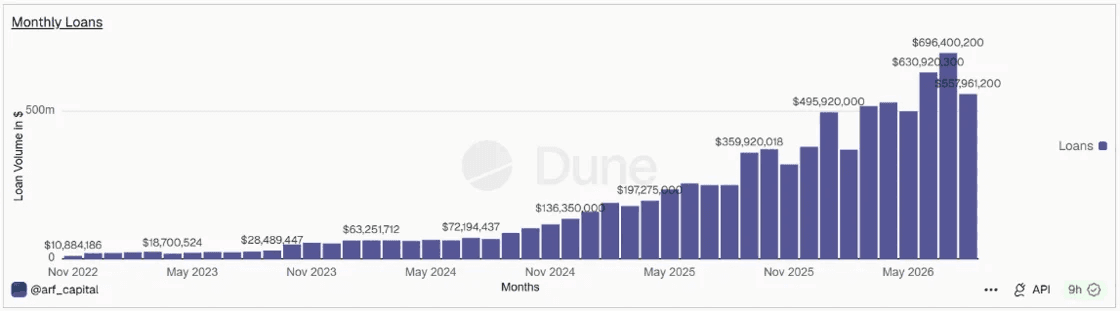
Source: Dune Dashboard by @arf_capital
Credit RWAs Are Broadening Beyond One Model
RWA.xyz's places distributed tokenized credit at $7.50B, up 4.57% over 30 days, across 2,563 assets and more than 193,000 holders. The same dashboard shows $35B of represented credit, down 3.39%. The distinction matters because distributed assets can move through onchain wallets and protocols, while represented assets primarily use a blockchain as a recordkeeping layer.
The distributed category is already diverse. It includes secured digital-asset lending, mining finance, senior loan funds, specialty credit, and payment receivables. Huma ranks tenth among credit platforms at roughly $234M. Its appeal is not simply a higher rate, payment financing adds a return stream linked to settlement turnover rather than Treasury rates or crypto leverage.
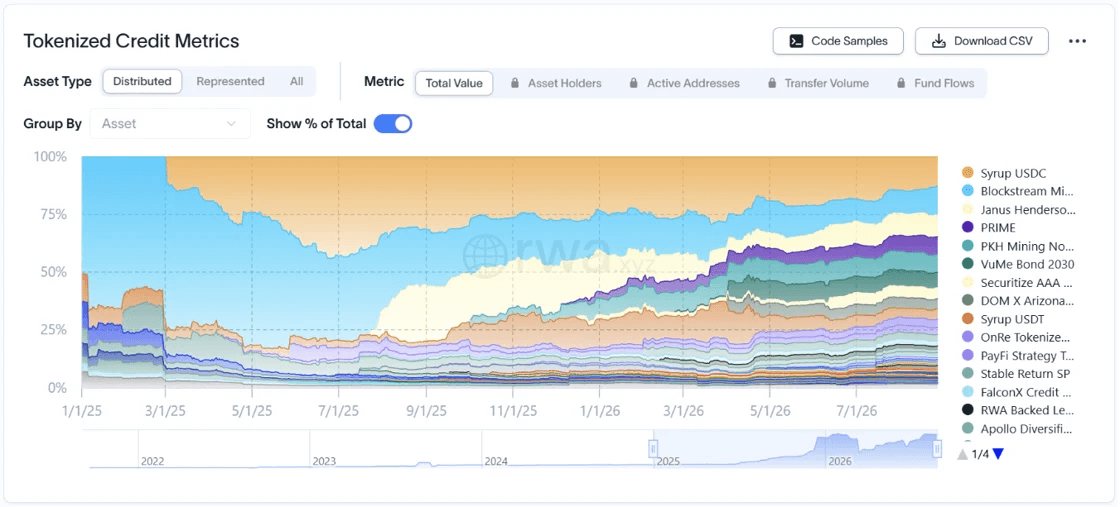
Source: RWA.xyz
What the Structure Still Requires
Onchain vault parameters make allocation limits and liquidity visible, but the underlying borrowers and payment flows remain partly offchain. Allocators still depend on underwriting, servicing, legal enforceability, valuation, and timely reporting. Accountable platform provides for Huma near-real-time verification that is cross-checked against monthly attestations from Swiss audit firm Wadsack, which improves monitoring.
The broader trend is therefore less about putting a loan token on a chain and more about building a distribution stack around credit. Sentora supplies curation and limits, Morpho supplies programmable lending, PYUSD supplies settlement liquidity, and Huma supplies the receivables.
Where This Goes Next
The PYUSD vault gives allocators a defined route into payment credit, with exposure caps, visible parameters, and repayment that comes from settlement flow rather than market direction. Huma brings the origination record behind that exposure, with more than $17B in payment volume and $8B of cumulative credit without a default, supported by near-real-time verification and monthly attestations from Wadsack. That combination of transparent onchain limits and disciplined offchain underwriting is what allows an asset like PST to scale with confidence.
Early usage supports the case, with more than $7M deposited and the majority already borrowed against PST. Payment receivables look set to become a durable component of onchain credit allocation.