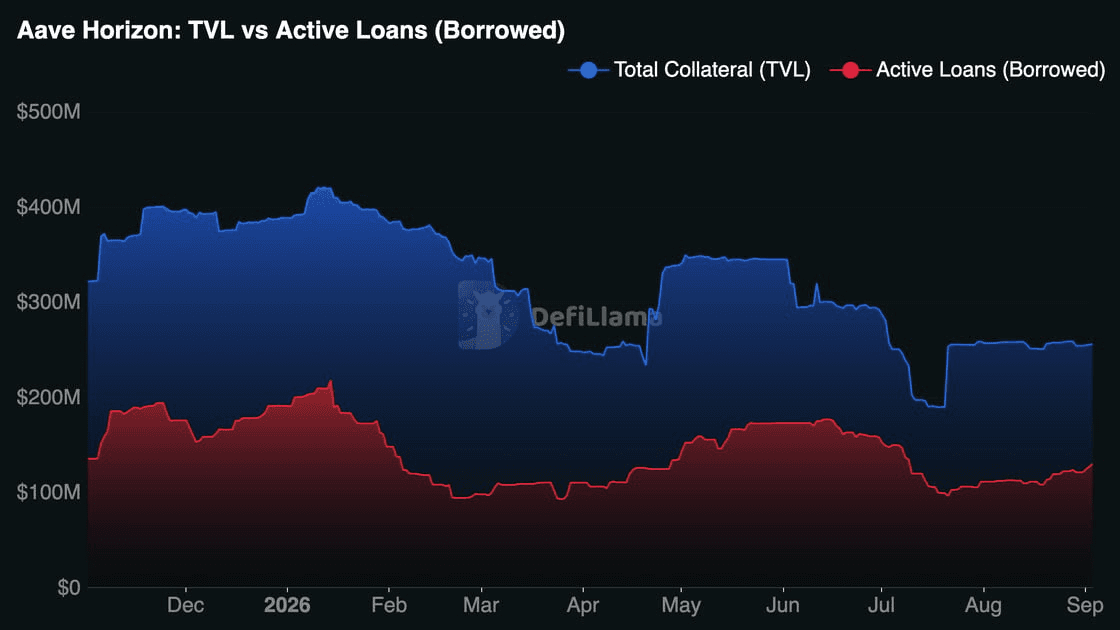
Aave Horizon remains one of the largest dedicated RWA lending markets onchain. DefiLlama currently tracks roughly $390 million in TVL and $134 million in active loans on Horizon, giving the market meaningful scale relative to the broader RWA-lending sector. Horizon operates on Ethereum and allows qualified investors to supply permissioned tokenized assets as collateral while stablecoin liquidity can be supplied permissionlessly.
The model is deliberately different from isolated RWA lending pools. Stablecoins supplied to Horizon enter shared liquidity reserves that can support multiple eligible collateral assets. This means each new institutional product does not necessarily need to bootstrap an independent USDC or stablecoin market from zero, potentially improving capital efficiency as the collateral universe expands.
The most relevant development this week is the proposed onboarding of mWIN, a tokenized actively managed fixed-income strategy managed by Wellington Management, issued through Midas and designed for onchain markets in collaboration with Sentora. The ARFC (a core stage in the Aave Governance process where detailed proposals and smart contract changes are reviewed)
was posted on August 27 and remained active in governance discussion through the weekend, with the next steps requiring an independent LlamaRisk assessment, technical review, Snapshot vote and ultimately an AIP before implementation.
The underlying strategy is materially different from the Treasury-heavy collateral that initially dominated institutional DeFi. mWIN's model portfolio includes:
40% CLOs
25% investment-grade corporate bonds
15% ABS
10% agency MBS
5% non-agency RMBS
5% CMBS
The portfolio carries an average A+ credit rating, approximately one year of effective duration and less than two years of spread duration. Its gross market yield is approximately 5.23%, around 107 bps above comparable U.S. Treasuries.
Tokenized Treasuries are useful collateral, but leveraged strategies become less attractive when stablecoin borrowing costs approach Treasury yields. Credit products such as mWIN introduce a wider spread. Midas estimates that if Horizon borrowing rates remain roughly 150–200 bps below mWIN's yield, users could potentially deploy recursive borrowing strategies targeting double-digit returns at around 4x leverage.
This creates a different source of demand for DeFi lending: borrowing becomes a potential carry trade rather than simply a way to access liquidity without selling an asset.
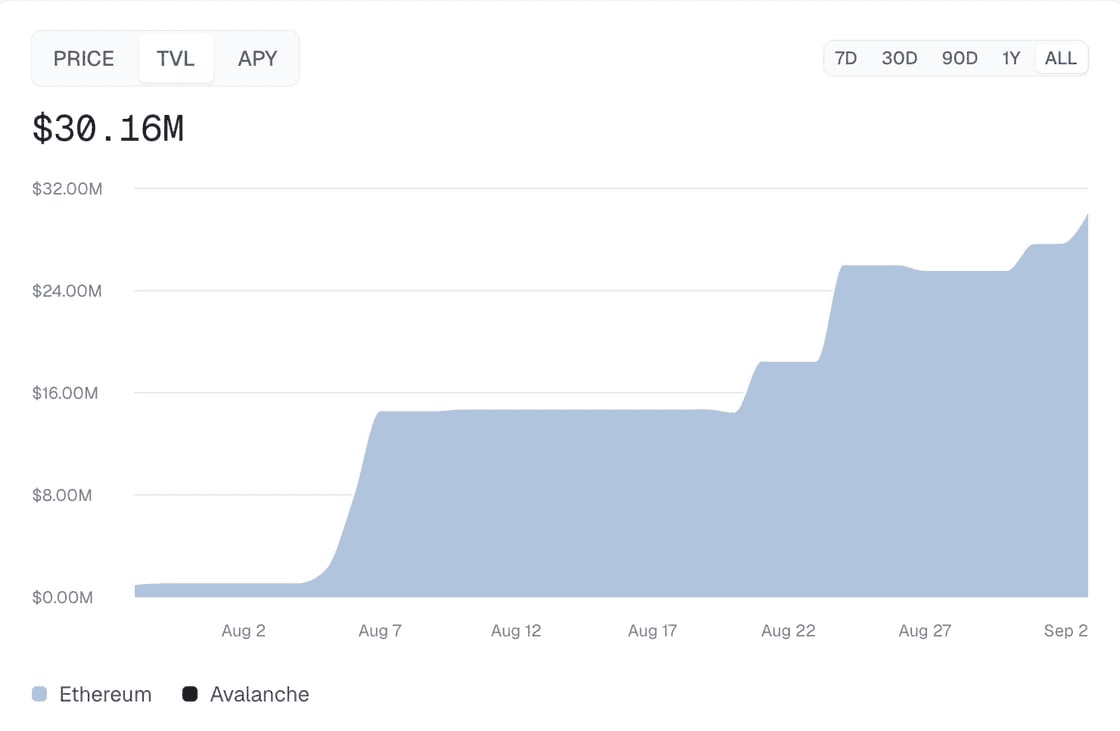
Early demand appears encouraging. The proposal states that mWIN attracted roughly $15 million shortly after launch, with fund size around $25 million and expectations to surpass $100 million. Midas also points to mGLOBAL, its Fasanara-backed credit product already integrated with Horizon, where an initial $30 million supply cap reportedly filled quickly.
The challenge is liquidation.
Unlike crypto-native collateral, mWIN's NAV is calculated on business days rather than continuously. Standard redemptions target T+1 settlement, while 5% of the portfolio is expected to remain in tokenized Treasuries. Midas also provides $10 million in instant USDC redemption capacity, supplemented by external liquidators.
This means Horizon's risk framework must account not only for price volatility, but also NAV latency, settlement delays and the capacity of approved liquidators. Final collateral parameters have not yet been established, making liquidation thresholds and oracle safeguards critical before onboarding.
Source: https://midas.app/mwin
The broader implication is that institutional DeFi lending is beginning to inherit risks that look increasingly similar to traditional credit markets.
Key considerations include:
NAV risk: credit funds are generally priced daily rather than continuously.
Liquidity mismatch: DeFi debt operates 24/7 while underlying securities settle on business-day cycles.
Permissioned liquidations: liquidators often need to be KYC/KYB-approved.
Credit-spread risk: collateral values can decline materially without an outright default.
Legal risk: transfer agents may have the ability to freeze assets under sanctions, court orders or regulatory requirements.
This also changes how DeFi protocols must think about risk management. Traditional metrics such as oracle deviation and DEX depth remain relevant, but institutional RWA lending additionally requires scrutiny of fund administrators, redemption mechanics, legal transfer restrictions and offchain liquidity.
The key takeaway is that Aave Horizon is gradually evolving from a venue for borrowing against tokenized cash-equivalent assets into an onchain financing layer for institutional credit. Higher-yielding collateral such as mWIN could create stronger, more persistent borrowing demand, but that comes with greater exposure to credit, settlement and liquidation risk.