What Arc Is
Arc is an EVM-compatible Layer-1 purpose-built for "financial markets, real-time money movement, and agentic economic activity". A few design choices separate it from a standard L1 launch:
USDC as native gas: users and applications pay transaction fees in USDC (with over 20 fiat-backed stablecoins supported for other uses), removing the need to hold a separate volatile gas token.
Sub-second deterministic finality, aimed squarely at payments and trading use cases rather than general-purpose smart contract activity.
A permissioned, institution-heavy validator set at launch. Founding validators include BlackRock, DTCC, Galaxy, ICE, Mastercard, MoneyGram, SBI Group, Standard Chartered, Sumitomo, Visa, and Worldpay. Circle has stated an intent to move from Proof of Authority toward Proof of Stake starting in 2027, but that transition has not happened yet.
A genesis mint of 10 billion ARC tokens was completed the same week as launch, though Circle has been explicit that this "does not amount to a commitment to publicly launch" a tradeable network token; fees remain payable in USDC for now.
The DeFi Numbers So Far
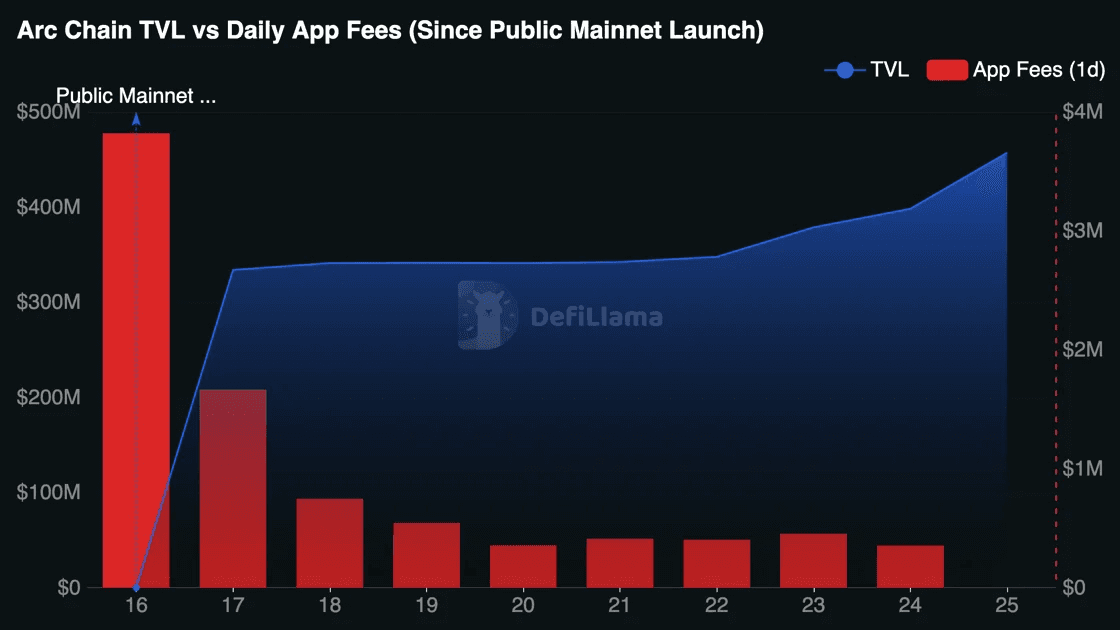
DefiLlama's tracked TVL for Arc stood at $481.7M as of this writing, up from $334.1M on September 17, the first day with a complete on-chain snapshot after the mainnet switch-on. That's +36.7% in roughly nine days.
Liquidity is heavily concentrated in on-chain credit:
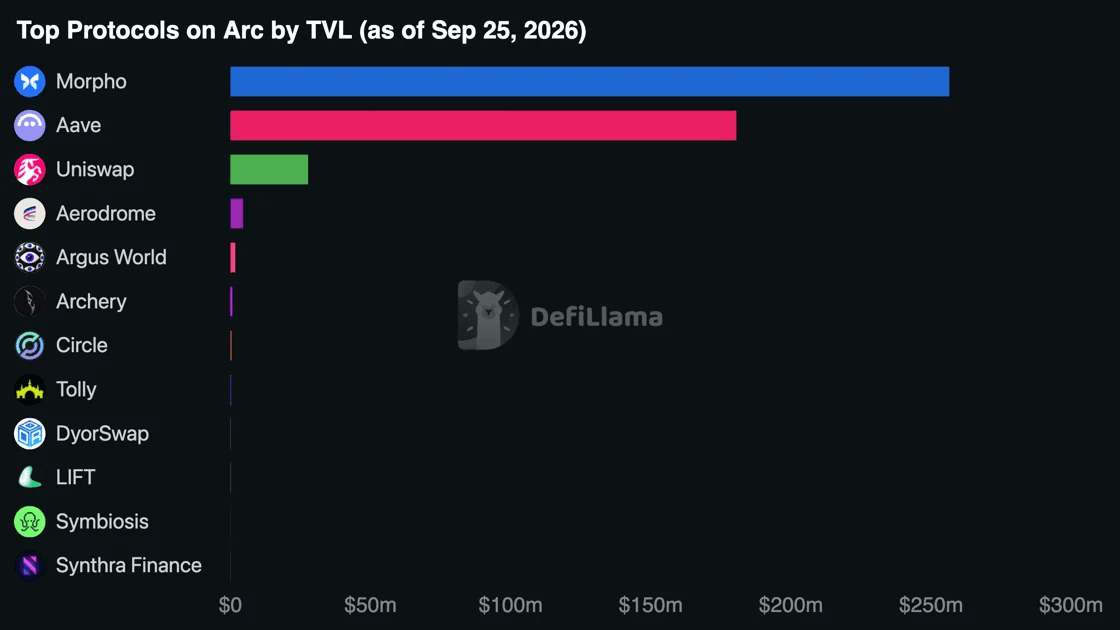
Morpho: $256.4M TVL, 53.2% of the chain
Aave (V4 market): $180.8M TVL, 37.5% of the chain
Uniswap (v2/v3/v4): $38.5M TVL, 8.0% of the chain, with $637.6M in cumulative 30-day DEX volume
Together, those three protocols account for roughly 98.8% of everything currently deposited on Arc. That's typical for a new chain, a few blue-chip protocols anchor initial liquidity before a broader long tail develops, but it means Arc's early TVL story is mostly three teams' deployment decisions, not yet a broad ecosystem.
Usage is thinner than the TVL headline suggests. Seven-day app-layer fees total $3.28M, and seven-day DEX volume is $412.4M. Externally reported (unverified against our warehouse) Aavescan data showed Aave's Arc market drawing about $76M in USDC supply within a day of launch, with borrowing under $100,000 and utilization near 0.1% as of September 17. In short: stablecoin liquidity arrived fast, but little has been borrowed against it yet, so the credit-market thesis for Arc remains unproven even as deposits look healthy.
Stablecoins and the Tokenized-Asset Pitch
Arc's stablecoin supply totals $513.0M, split as USDC ($502.7M, 98.0%), EURC ($9.2M, 1.8%), and GBPA ($1.0M, 0.2%). That dominance is by design: USDC isn't just the largest stablecoin on Arc, it's the chain's gas token, so its share is structurally guaranteed to stay elevated regardless of which other assets gain traction.
The more ambitious part of Arc's pitch is real-world-asset composability. Circle has publicly named several tokenized instruments as native to Arc's markets, including USYC (a tokenised money-market fund), BlackRock's BUIDL, Maple's syrupUSDC,private-credit funds, all pitched as usable for trading, lending, and collateral from day one. None of these RWA assets are onboarded on the Arc chain.
What to Watch
A few open questions will determine whether Arc's early numbers compound or stall:
Utilization on the lending side. Deposits arrived fast; borrowing has not. If Aave's and Morpho's utilization stays near launch-day lows even as supply caps are raised, Arc's credit market risks becoming a large pool of idle stablecoins rather than active onchain credit.Validator decentralization. The founding validator set is institutional and permissioned. Circle has floated a 2027 shift toward Proof of Stake, but until that happens Arc's trust model looks closer to a consortium chain than a fully open L1.
RWA data transparency. Until tokenized assets like USYC, BUIDL, syrupUSDC show up in independently tracked datasets on Arc, claims about their usage there rest on the issuer's own disclosures.
Concentration risk. With roughly 99% of TVL in three protocols, any stress event at Morpho or Aave's Arc markets would be a stress event for the entire chain.
Arc launched with unusually strong institutional backing and a clear stablecoin-first design, and its first ten days of tracked DeFi activity ($481.7M TVL, $513M in stablecoin supply, three blue-chip protocols carrying nearly all of it) are a credible start for a brand-new chain. But early deposits are not the same as proven usage: utilization on the credit side remains very low, RWA claims aren't yet independently verifiable in our data, and the validator set is still centralized by design. This is not financial advice, and given the concentration in a handful of protocols and the newness of the network, treat any Arc-native yield or lending opportunity as higher-risk than an equivalent position on an established chain until usage data broadens out.