
Spark FX Layer: One Book for Many Stablecoins
Issuing a stablecoin is no longer the constraint. Payment companies, brokerages, fintechs, and bank consortiums in Europe and Japan have all launched or announced dollar tokens, and the supply side keeps widening. Chainalysis put 2025 stablecoin transaction volume at $28 trillion. The barrier to growth now sits after issuance, in the work of integrating a new token into the venues, wallets, and liquidity that make it usable.
Every new issuer inherits the same requirement. A dollar token is useful only if it converts cleanly into the other dollar tokens people already hold, and that conversion needs depth. Depth built one issuer at a time divides the available capital further with each round.
Spark, the liquidity arm of Sky, is building a single shared book. It moved roughly $150 million into Uniswap v4 on June 25, quoted in USDS, with USDS/USDT and PYUSD/USDS as the first two pairs. RLUSD/USDS followed on July 31. Issuers connect into common inventory instead of raising their own, and Sky governance sets the allocation and risk parameters around it.
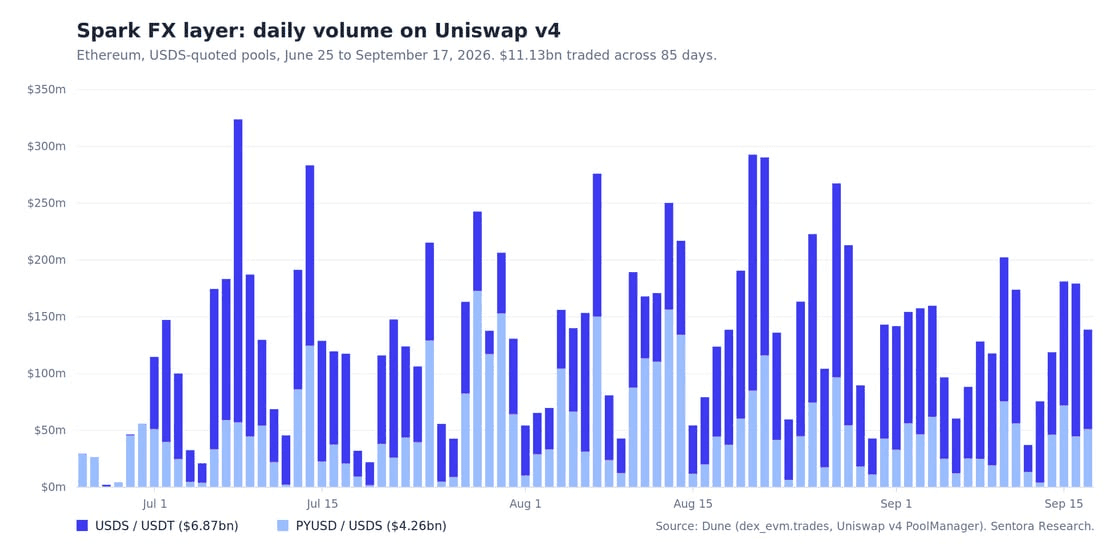
Volume has been consistent. The two original pools have traded $11.13 billion in 85 days, an average of $131 million a day, with $4.43 billion of that in the trailing month. Adding RLUSD/USDS takes the layer past $12.1 billion. Uniswap already carries close to 60% of stable-to-stable volume on its major networks, which is where that flow already sits.
Inventory That Stays Allocated
Shared depth costs money to hold. Capital committed to an AMM can be traded against at any moment, and between trades it does nothing. On stable pairs, where fees run in fractions of a basis point, lending interest can exceed what the pool pays. Market makers have had to choose between the two.
DualPool removes that choice. It is an open-source Uniswap v4 hook, designed with Spark and built by Uniswap Labs, and it went live on July 22. Spark will operate the largest deployment, which is the destination for the $150 million it moved in June.
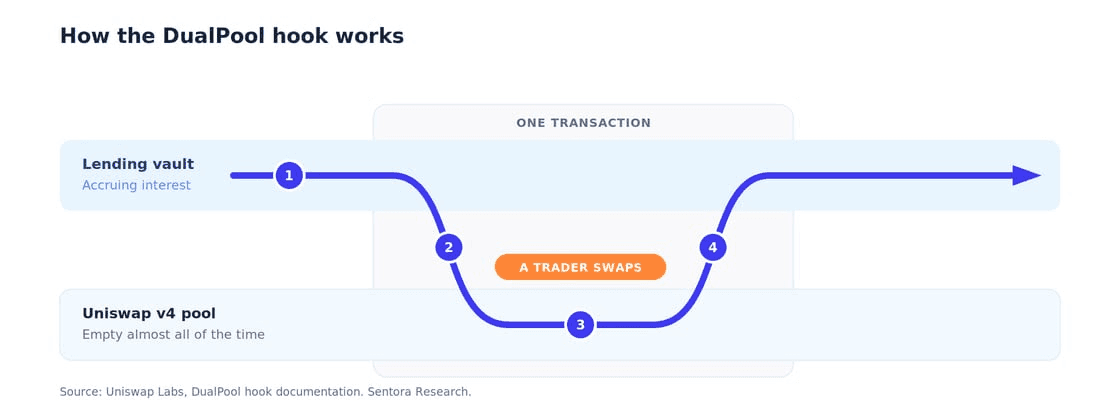
The cycle runs inside a single transaction:
Waiting. The pool's stablecoins sit in ERC-4626 lending vaults and accrue interest. The pool itself holds close to nothing.
Measuring. A trade arrives. The hook calculates the smallest amount of capital that trade requires and withdraws only that amount.
Trading. That capital is placed as concentrated liquidity across the price ranges the operator configured, and the swap runs on standard Uniswap v4 math.
Returning. The remainder, plus the fee just collected, goes back into the vaults.
Three properties follow from that loop:
The inventory stays allocated almost all of the time. It leaves the vault for the length of one swap and returns in the same transaction.
The design requires no operation. The swap itself moves the capital, so there are no keepers, bots, or scheduled rebalancing.
Execution is standard. Routers, aggregators, and wallets trade against the pool through the v4 path they already use, with the same slippage limits.
The operator's control is limited to the shape of the liquidity. It is deployed across a weighted set of tick ranges instead of one band, and that distribution can be replaced between swaps: tight around the peg in calm markets, wider and more defensive in stressed ones. Three things are fixed at pool creation and cannot be altered afterward. The fee is static, the vault binding is permanent, and every swap runs the standard v4 math. OpenZeppelin audited the hook and reported no critical or high severity findings.
What the Design Allows
The hook is open source and deployable by anyone, so its reach extends past the pools Spark operates today.
More issuers on the same book. Spark's stated aim is shared infrastructure that hundreds of issuers plug into, with the issuer handling product and distribution while Spark coordinates liquidity.
Yield-bearing dollars as inventory. Spark points to demand for digital dollars that track short-term rates while staying settlement-ready. A pool whose idle capital already sits in a vault is a natural home for that.
Issuer-operated depth. An issuer or market maker can deploy its own DualPool, select its own vaults, and hold working depth in its own token while that capital stays allocated.
Peg defense as a configuration. Ranges are weighted and one-sided shapes are permitted, so an operator with a mandate to defend a peg can stack progressively deeper support on the vulnerable side.
Beyond the dollar. The same structure applies to any pair with thin fees and a strong lending market, which is where non-USD stablecoins and tokenized cash instruments would sit.
The last three describe what the design permits. None have been announced. Each also depends on the vaults an operator selects, because idle capital sits under a standing allowance to them.
The immediate milestone is Spark migrating its USDS-quoted book onto the hook. At that point the same $150 million supports the same depth while staying allocated in lending vaults between trades.