
Two stories this week are about making tokenized credit usable.
On August 18, Securitize and Neuberger launched the Neuberger Securitize High Income Tokenized Fund (HINC), and Securitize posted an ARFC to list it as supply-only collateral on Aave Horizon, with USDC, GHO, and RLUSD borrowable against it. If governance agrees, it would be the first sub-investment-grade credit collateral on that venue.
A day later, Centrifuge added Symbiotic's Liquid Lane across about $1.6 billion of tokenized funds (Janus Henderson JAAA and JTRSY, NYLIM HYB): an onchain RFQ so eligible holders can take USDC now while ordinary redemptions still settle on their own clocks.
Tokenized RWA sitting in DeFi was about $3.98 billion as of August 18, 11.5% of $34.64 billion issued. Most of that book still sits as a custody wrapper. These two moves attack that from opposite ends: borrow against the token, or exit it without waiting for the transfer agent.
HINC: Sub-IG Credit Proposed for Horizon
HINC is a BVI professional fund. Securitize Capital is the investment adviser; Neuberger Berman Investment Advisers (NBIA) is the subadvisor with discretionary authority. The ARFC puts NBIA at about $567 billion AUM as of 31 March 2026. Securitize's launch release uses a later firm-level print: Neuberger at about $613 billion as of 30 June 2026, with more than $230 billion on the fixed-income platform. Fund term commenced August 18, 2026. Tokens are permissioned DSTokens on Ethereum (the same Securitize stack Horizon already uses for VanEck's VBILL), with share classes also issued on Avalanche, Solana, and Sui. Horizon itself is Ethereum-only.
The portfolio is what matters. Majority high-yield corporates, with the balance in CLO tranches, bank loans, and other high-yielding credit, plus a liquidity sleeve of cash equivalents and tokenized Treasury/MMF instruments. No fund-level leverage. Management fee 0.50%, TER 0.60%, minimum subscription $100,000. Income is reinvested: HINC is a NAV-accruing, non-rebasing token. Redemptions target T+1; an optional instant liquidity pool (fee up to 2%) is expected to be unavailable at launch. Eligible accredited investors and qualified purchasers only (Reg D 506(c) / Reg S), wallets allowlisted at the contract.
Horizon's live collateral set is concentrated in tokenized Treasuries, government MMFs, and investment-grade credit: Superstate USTB, Circle USYC, VanEck VBILL, Janus Henderson JTRSY, and JAAA (AAA CLO), among others. The ARFC's argument is that when collateral yields sit close to the stablecoin borrow rate, borrowing is a cash-management draw rather than persistent carry demand. HINC is pitched to sit above that. Supply-only: you can post it, you cannot borrow it. Securitize I, Inc. has committed $1 million of seed collateral to open the market if the listing proceeds. Go-live is gated on at least one KYB'd liquidator already onboarded as a holder of record; the token cannot move to a wallet that is not on the allowlist.
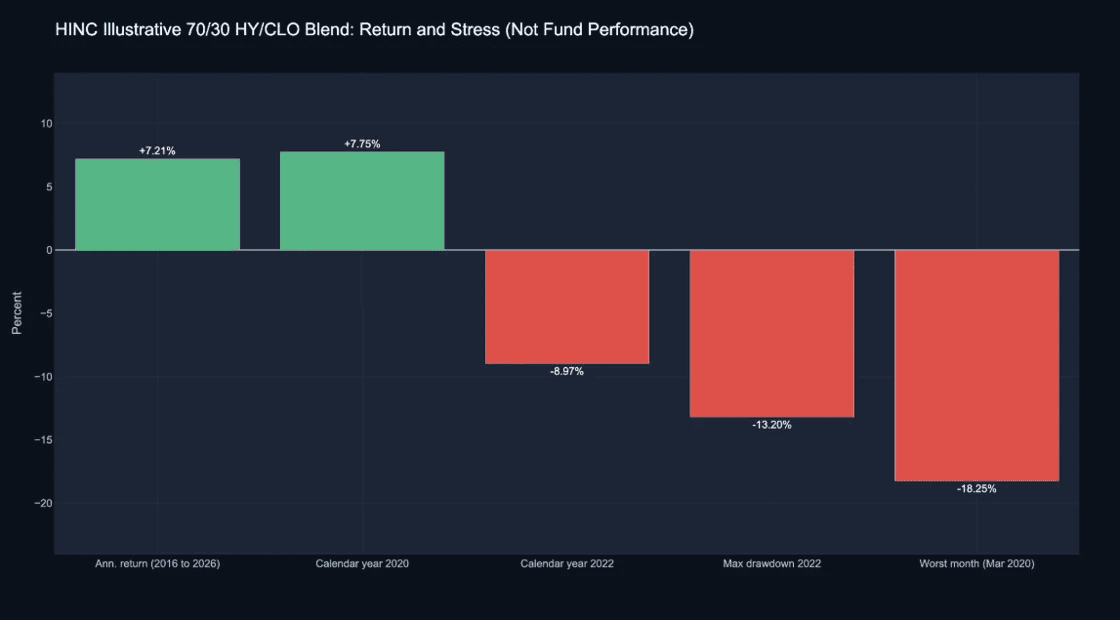
HINC has no operating history, so Securitize put an illustrative index blend in the ARFC for Aave risk reviewers: a stand-in portfolio they can use to set liquidation and LTV parameters before live Fund NAVs exist. The blend is 70% ICE BofA US HY Constrained / 30% J.P. Morgan CLOIE Post-BB (daily, constant-weight, July 2016 to July 2026), deliberately run at the maximum contemplated CLO sleeve. It is a risk-parameterization input, not a performance claim. The model prints about +7.21% annualized, a March 2020 worst month of -18.25% (the ARFC's governing stress case), and calendar 2022 at -8.97% with a -13.20% max drawdown inside the year. Rate duration is short (2-3 years); spread duration is longer (3.5-4.5 years). Those figures exclude fees, trading costs, defaults, and actual holdings.
NAV for this collateral type is struck once per business day, so the ARFC asks for windowed unwind rather than a millisecond backstop. Open items the issuer flags itself: Chainlink NAV-link plus LlamaGuard bounds still to be locked; LlamaRisk has not published. RedStone is already pushing daily NAV on Ethereum, Avalanche, and Solana via TSSO for the issuance side; Horizon is expected to use a Chainlink feed for the lending market.
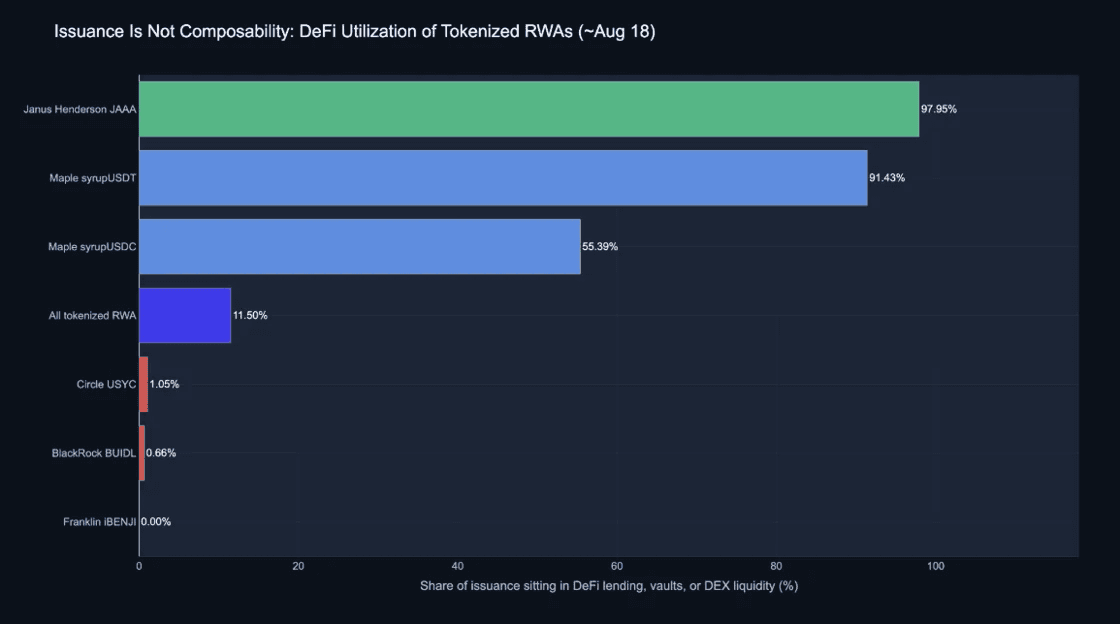
The utilization print is useful context for why a Horizon listing would matter. As of August 18, DefiLlama-style coverage puts $3.98 billion of tokenized RWA inside DeFi lending pools, vaults, and DEX liquidity, against $34.64 billion issued (11.5%). BlackRock BUIDL is $2.74 billion issued and about $18 million in DeFi (0.66%). Circle USYC is similar: roughly $3.0 billion outstanding, about $31.5 million in DeFi (1.05%). Franklin iBENJI is about $1.5 billion and zero DeFi use. By contrast, Maple syrupUSDT is around 91% utilized and JAAA around 98% on $423 million. Aave's Horizon page still puts deposits above $440 million since the August 2025 launch. Putting size on-chain and getting it used as collateral are still separate steps. HINC is structured to be posted; BUIDL was structured to be held.
Liquid Lane: Onchain RFQ Across JAAA, JTRSY, and HYB
On August 19, Centrifuge and Symbiotic turned on Liquid Lane for three funds that Cointelegraph and Symbiotic's GlobeNewswire both put at about $1.6 billion: Janus Henderson JAAA (AAA CLO), JTRSY (short-duration U.S. Treasuries), and New York Life Investment Management HYB (U.S. high-yield corporates). Janus Henderson is about a $500 billion manager; Cointelegraph notes JAAA alone had been around $1 billion TVL by late 2025.
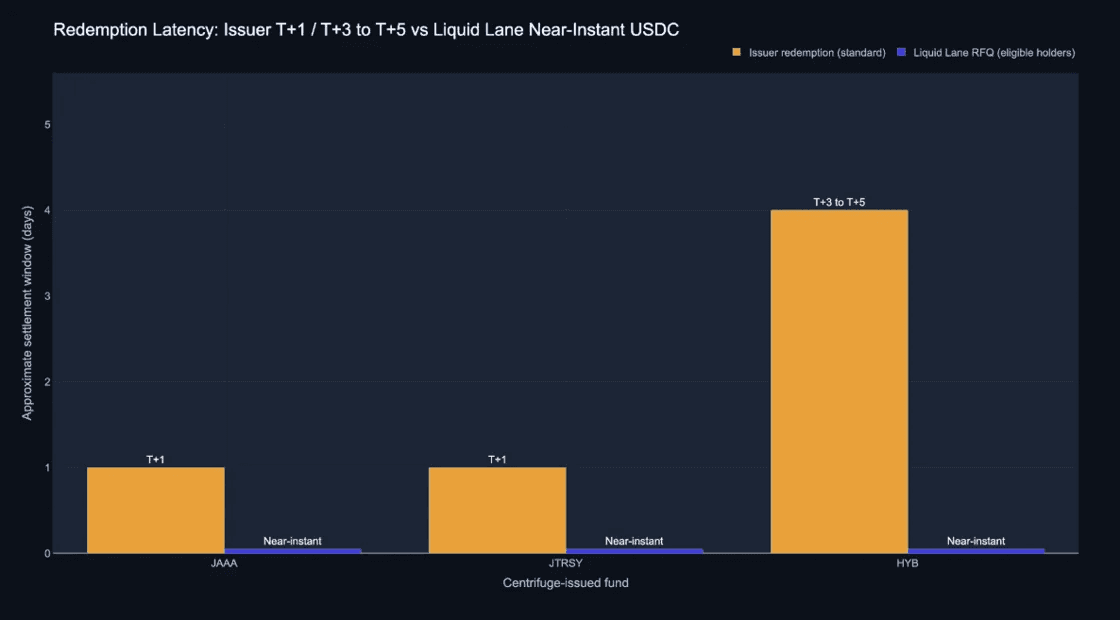
The setup is an onchain RFQ marketplace rather than a new share class. Eligible holders request a USDC quote. Market makers fill from Symbiotic vault liquidity, then redeem the fund tokens with the issuer or sell them in another RFQ. The holder gets USDC immediately. The fund's ordinary redemption still runs. For JAAA and JTRSY that ordinary window is T+1. For HYB it is T+3 to T+5. Liquid Lane does not replace those calendars. It sits in front of them.
This is not the first fast exit on Centrifuge. Wintermute has offered 24/7 instant redemptions on JTRSY since February 2025. HYB launched in June with its own near-instant arrangement. Felix Lutsch, Symbiotic's head of ecosystem, told Cointelegraph the difference is the capital structure: one shared vault base across assets, so market makers do not have to pre-fund inventory fund by fund. The hard part has been getting enough flow for dedicated inventory to pay, not raw settlement speed. Tokenized funds do not trade enough for that model to work fund by fund. A shared RFQ is a bet that aggregated redemptions, plus collateral use, can make the inventory worth running.
JAAA shows the issuance-versus-use gap clearly: CryptoSlate's DefiLlama-style table has it 97.95% utilized ($414.3 million of $423 million in DeFi). When protocols accept a CLO token as collateral, it gets put to work; a T-bill token held only for yield often stays in a wallet. Liquid Lane covers the other case: if you cannot borrow against a position, you still want a path to USDC that is not a multi-day transfer-agent cycle.
For DeFi and institutional allocators, the near-term question is whether credit tokens get used as collateral or just get a faster bid. Horizon still has to run LlamaRisk, onboard liquidators, and take a Snapshot, then an AIP. Liquid Lane still has to print size at tight quotes, not just exist as a route. Watch whether HINC, if listed, actually pulls borrowed TVL, and whether RFQ flow on JAAA/JTRSY/HYB is repeatable or a launch-week facility.