Compliance Moves From The Interface To Settlement
A frontend gate can block a user from one website without stopping direct contract interaction through another router. Uniswap's Permissioned Pools move the eligibility decision into the pool's execution path. The hook checks an issuer-controlled allowlist before every swap and before an LP position is created.
This does not make Uniswap v4 broadly permissioned. Standard pools remain open, while an issuer can choose the restricted standard for an asset whose ownership or transfer rules require approved wallets. The result is a parallel market structure inside the same protocol rather than a protocol-wide identity layer.
How the Architecture Works
A Permissions Adapter holds the regulated underlying token, while Uniswap's pool manager contract accounts for a compatible wrapped representation. Approved routers wrap assets as they enter and unwrap them as they leave. The hook checks both currencies in a pool and distinguishes if swapping or depositing liquidity is allowed. So an address approved to trade does not necessarily qualify to provide liquidity.
The design also closes common routing gaps. An unauthorized address cannot bypass checks by placing a restricted asset in the middle of a multi-hop route. Permissioned LP NFTs are non-transferable, which prevents an approved LP from selling the position to an address that has not completed the issuer's eligibility process.
A Standardized Institutional Lane
Superstate helped shape the design for tokenized funds and equities. Securitize worked with Uniswap Labs on compatibility for DS Protocol assets, while Dowgo contributed ERC-3643 support. This gives issuers a reusable AMM layer instead of requiring a separate trading stack for every regulated token.
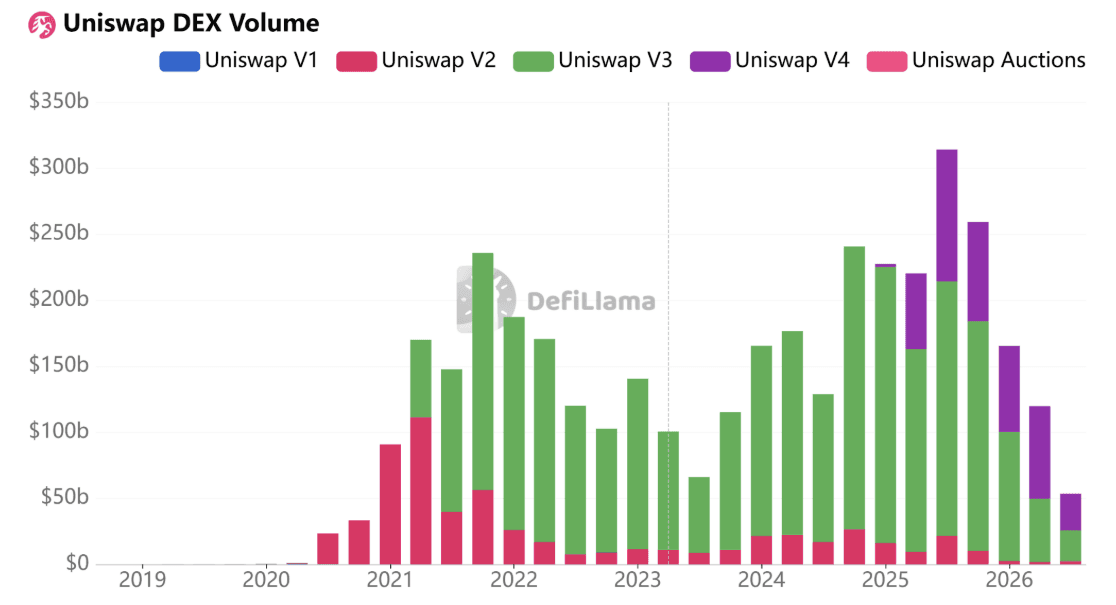
Uniswap’s volume history shows how quickly liquidity can migrate to new protocol generations. V3 has dominated activity since 2021, but v4 is already capturing a meaningful share, helping push quarterly DEX volume above $300 billion at its 2025 peak. Permissioned Pools build on that growing v4 base, offering regulated issuers a standardized trading lane without changing the open structure of existing pools.