
Euro-denominated tokenized cash has not lacked for credible issuers. Circle and Société Générale, two giants from the on-chain and traditional finance sectors, each issue their own euro-backed stablecoins. Regulatory data recorded seventeen authorised e-money token issuers across ten member states by mid-2026, covering twenty-five approved single-currency tokens, and Qivalis, a consortium of 37 banks (including ING, UniCredit and CaixaBank) seeking a Dutch EMI licence and targeting an H2 2026 launch has announced a further one.
What none of that issuance has produced is depth. The largest euro token in the market is smaller than several individual lending vaults on public blockchain networks, and the segment in aggregate has stayed below one percent of tokenized cash outstanding worldwide since the category began.
Revolut's EURR, launched to customers in Denmark, Poland and Portugal in August 2026 ahead of a wider European rollout, arrives with something none of its predecessors had: Revolut has one of the largest retail customer bases in European financial services, licences to reach it directly across the European Economic Area, and an app those customers already use for payments, currency exchange and digital assets. If access to a euro-denominated token were the binding constraint on the segment, EURR would resolve it within a year.
Therefore, the argument here is that access was not the binding constraint. The euro segment has stalled for reasons that sit inside the legal design of the instrument and the structure of the markets it trades in, and customer distribution addresses the smallest of them. What follows sets out what went wrong, what has been demonstrated to work on the same problem in dollar-denominated markets, and what applying that approach to a euro token would require.
A Market with Many Issuers and Very Little Depth
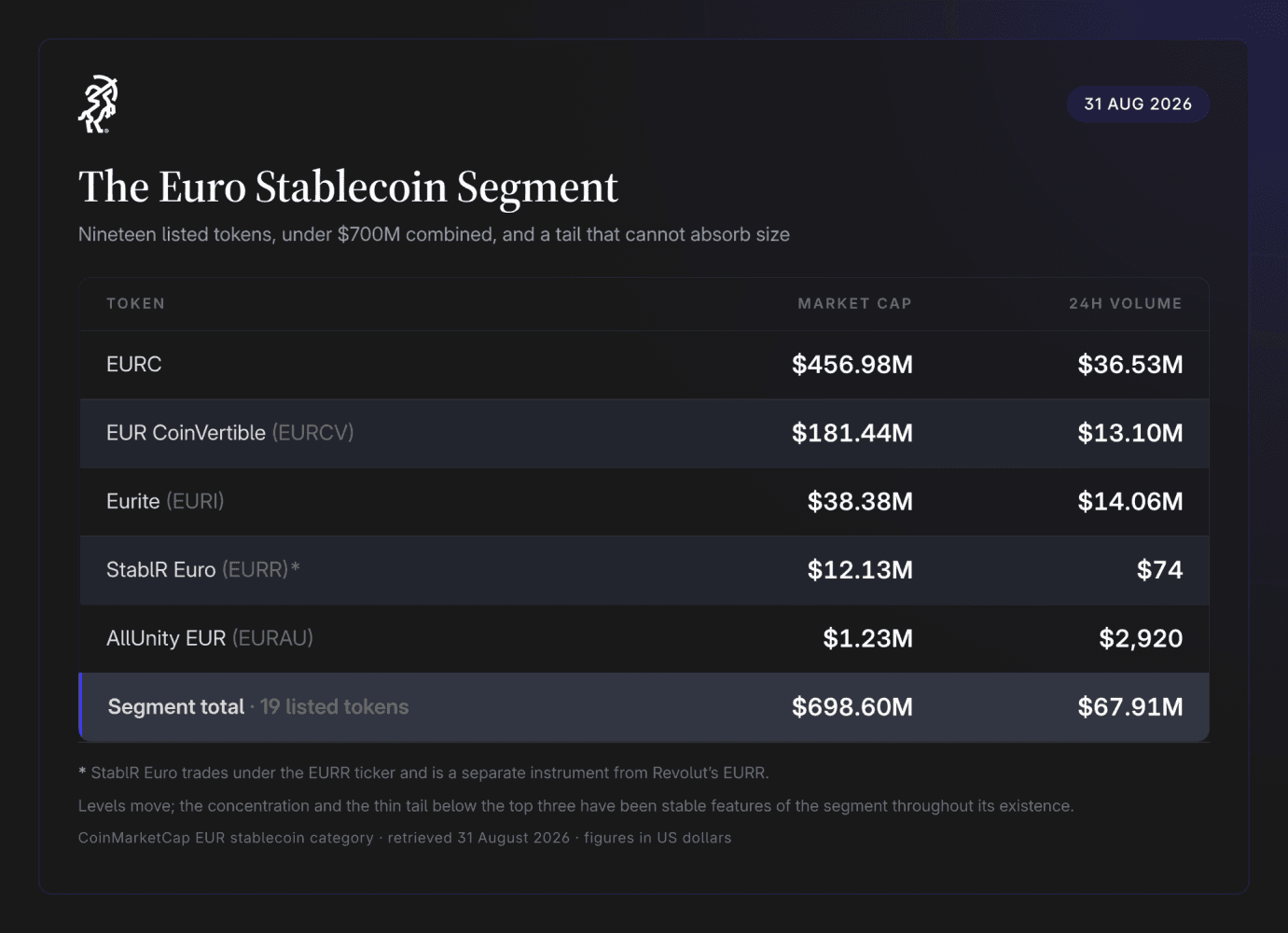
The shape of the euro segment tells the story more clearly than its size: one token holds roughly two thirds of it. A second holds most of the remainder. Below those two, market capitalisations fall into single-digit millions and daily turnover in several cases falls into the low thousands of dollars, which is to say that a serious institution cannot enter or exit a position of any size without moving the price against itself.
By comparison, the global tokenized cash market is approximately $300 billion, with 98–99% of that liquidity denominated in dollars and highly concentrated, as two issuers hold nearly 90% of the total. While the euro segment is growing, having expanded significantly since MiCA came into effect, it remains negligible in absolute terms. Despite S&P Global Ratings forecasting a range of €25 billion to €1.1 trillion for the sector by 2030, against a €570 billion baseline, current adoption is still minimal.
How European Rules Removed the Reason to Hold Euros On-Chain
MiCA Article 50 prohibits issuers of e-money tokens, and the crypto-asset service providers offering services around them, from granting interest or any benefit tied to how long a holder holds the token. A euro-area saver holding a euro-denominated e-money token therefore forgoes whatever return their bank account or money market fund pays, while the issuer retains the income earned on the reserve.
The instrument is defined in law as a means of payment and settlement with no running return attached, and that is a deliberate policy choice intended to stop tokenized cash competing with bank deposits.
Because holding pays nothing, the remaining case for holding is transactional, and transactional demand for euros on public networks has stayed small. The consequence is visible in borrow rates, where euro supply markets on the major lending venues consistently pay materially less than dollar markets on the same venue for the same nominal risk. That gap is a direct measurement of how few people want to borrow euros against digital-asset collateral, and a supply market without borrowers generates nothing to compensate a holder for the deposit rate they gave up. The instrument and the market reinforce each other's weakness.
European regulation does protect the segment, though the protection is defensive rather than generative. MiCA requires the issuer of a non-euro e-money token used widely as a means of exchange inside the EU to halt issuance once usage crosses a quarterly average of one million transactions a day and €200 million in daily value within a single currency area, and to file a remediation plan with its regulator within 40 working days. No equivalent ceiling applies to euro-denominated e-money tokens.
In short, the rule constrains the dollar without giving anyone a reason to hold the euro, and the space it clears has stayed largely empty.
What has filled that space instead is fragmentation. Nineteen tokens divide a market smaller than a single mid-sized lending vault, spread across roughly twenty networks with Ethereum carrying around two thirds of the total. A settlement asset works through concentration, and euro issuance has scattered thin supply across venues that individually cannot support size. A Eurosystem survey cited by Christine Lagarde found that the absence of a widely accepted tokenized settlement asset has already constrained tokenization adoption in Europe, which is the same problem observed from the buyer's side of the market.
Lessons from the Dollar-Backed Stablecoin Market
The euro segment's failure is not a law of nature, and the evidence for that is what happened when the same problem was attacked deliberately in dollars.
When PayPal and Paxos set out to build PYUSD demand on Solana, the programme they ran with Sentora was a market-building exercise. It combined a four-phase go-to-market plan, incentive distribution metered against measured deposit growth, integration work across venues, self-custodied accounts and exchanges, and capital formation from an existing institutional client base. It produced $700 million in net new capital deployed within two months against a $500 million objective, on 35% of the allocated budget.
Buying supply and keeping it are separate problems, and the euro segment would need to solve the second one. Incentives rent supply for the length of the budget. Borrowing demand holds it afterwards, because a depositor paid out of what borrowers owe has a reason to stay that outlasts any campaign. In other words, supply that arrives for an incentive departs when the incentive stops.
Sentora's PRIME vault on Morpho is a good example of organic demand: a holder of PYUSD deposits it into the vault, and the vault lends it out against PRIME, a token backed by home equity loans originated by Figure. Whoever borrows the PYUSD pays interest for as long as the loan stays open, and that interest goes to the depositor.
The result is a reason to hold PYUSD grounded in economic utility.. The return comes from an operating lending business, so it continues after any launch campaign ends and it grows with borrowing activity. Deposits reached more than $200 million within three months of the vault opening, drawn mainly from institutional investors and large capital deployers.
Kraken's earn programme shows the same structure carrying a consumer platform's own customers, surpassing $800 million and more than 100,000 depositors in 8 months by routing them into curated vaults. That second case is the closest existing analogue to what a euro token distributed through a large retail app would be attempting.
What these programmes share is the element the euro segment still lacks: each created reasons to hold the token that were independent of the issuer paying for the privilege, and each did it by building the borrow side of a market before opening the supply side.
The Work That Would Put Demand Behind a Euro Token
Applied to a euro-denominated token operating under MiCA, that approach implies a specific sequence, and the ordering carries most of the value.
Build borrow demand before supply. A lending market with depositors and no borrowers pays nothing and retains nobody. The work involves identifying collateral that European holders already own and want to borrow against without selling, then underwriting it properly. The precedent already exists in euros, where cheap euro borrowing against Bitcoin-denominated collateral on Morpho has driven measurable supply growth for at least one bank-issued euro token.
Make the token a collateral asset rather than only a quote asset. A token that sits on one side of a trading pair has no structural holders. A token accepted as collateral in curated markets gives institutions a balance-sheet reason to hold it.
Establish a liquid on-chain EUR/USD market. Continuously quoted EURR against a major dollar token is a precondition for the collateral and lending roles above, because euro collateral cannot be priced, marked or closed out against dollar borrowing rates without a reliable on-chain reference. The same pair serves customers directly. Retail holders able to execute EUR/USD at any hour on competitive terms have a reason to keep balances in euros instead of converting out, and European institutions earning dollar-denominated returns on-chain can convert them without leaving the chain.
Deploy through a governed on-chain mandate. An on-chain mandate is the written set of rules, limits and oversight determining where capital may be deployed and on what terms, paired with an approved list of venues that have passed documented due diligence. This is the artefact a European risk committee reviews, and it is what separates a supervised programme from a discretionary position.
Meter incentive distribution against measured outcomes. The Solana programme exceeded its target by 40% while spending roughly a third of its budget, because payment tracked observed deposit growth rather than a schedule.
Seed depth with institutional capital before opening retail distribution. Retail flow arriving into a market that cannot absorb it produces price impact and complaints rather than adoption.
Publish positions continuously. Continuous attestation, meaning verification of positions and backing on an ongoing basis rather than at a reporting date, is available on-chain at no marginal cost and answers the reserve question a European risk committee asks first.
The residual exposures travel with the approach and belong in the paper rather than outside it. Code-execution risk survives every audit, controlled through parameter design, exposure caps and continuous monitoring rather than eliminated. Collateral enforcement at an unfavourable price transfers loss to depositors, controlled through conservative loan-to-value limits and buffers held below maximum borrowing capacity. Euro market depth is thin enough that exit at size is a genuine constraint, which argues for absolute supply caps sized to the collateral. And Article 50 governs what an issuer and its service providers may grant to holders, so any structure intended to generate a return on euro balances requires review against that provision with counsel and the competent authority before it reaches a customer.
The Short Race to Define the Euro Standard
Revolut has solved the hardest problem in the euro segment: putting a euro-denominated token in front of tens of millions of people who earn and spend in euros. That solves distribution, but it leaves untouched the borrow demand, the collateral role and the market depth that made the dollar segment self-reinforcing. More importantly, no euro issuer has yet built any of the three deliberately.
Years of euro issuance have established the true constraint with unusual clarity: Europeans decline to hold a token that accomplishes nothing while they do so, and no launch, however well distributed, changes that on its own.
A token becomes worth holding when it acquires functions its issuer is unable to grant: a reason for someone to borrow it, acceptance as collateral in its own right, and a role in settling transactions. Those functions get built in the market rather than in the app, through underwritten collateral, defined lending parameters and venues that have passed documented diligence, and the timetable for that work has little in common with a product launch.
Without it, the likeliest outcome for EURR is a quiet one, in which the token works well as a feature inside the Revolut app, moves money between customer accounts, and never becomes an asset that anyone outside the app has a reason to hold. Every euro token issued so far has settled somewhere in that territory, and distribution rescued none of them.
Sentora has successfully executed this strategy in the dollar market by driving PayPal adoption on Solana. The euro version is the same work carried out in a thinner market under tighter rules, where the binding constraint is time rather than method. The first euro token that institutions can borrow, lend against and settle in will become the reference the rest of the segment prices around, and that position is still unclaimed.
Sources:
CoinMarketCap EUR stablecoin category (31 August 2026)
DefiLlama aggregate supply series via Reap stablecoin statistics (13 August 2026)
Christine Lagarde, "Stablecoins and the future of money", Banco de España LatAm Economic Forum, 8 May 2026
S&P Global Ratings euro stablecoin outlook (3 February 2026)
Token Terminal euro segment data via Bitcoin World (August 2026)
Regulation (EU) 2023/1114, Articles 23, 50 and 58
AlphaGrowth Base lending survey (August 2026)
Revolut blog, "Introducing EURR" (8 August 2026)


