While on-chain financial markets already process hundreds of billions in tokenized cash through lending venues, liquidity pools, and settlement rails, the next phase of decentralized finance depends on expanding the variety and types of assets these rails support.
Tokenized assets (such as Treasuries, bonds, credit, equities, commodities, and structured products) bring external value into DeFi, drawing cash flows directly from traditional rates, credit, and equity markets. In contrast, tokenized cash and stablecoins do not generate native yield, but they serve as the underlying settlement layer to price, transfer, and settle these assets.
This article examines how tokenized assets enhance decentralized finance, clarifies the specific advantages and limitations of each claim, outlines structural shifts in on-chain markets, and details how risk frameworks must evolve as traditional and decentralized finance converge.
Where On-Chain Yield Comes From Today
Every yield quoted in on-chain markets traces back to digital asset prices.
Lending is the most direct path: depositors earn interest from borrowers who post digital assets as collateral to draw tokenized cash and expand their positions. Borrowing demand fluctuates with asset prices, so the deposit rate reflects overall leverage appetite.
Liquidity venues follow a similar path, paying fees from trading volume that spikes during volatile periods.
Staking bypasses these steps by paying rewards in the network's native token, tying the dollar value of payouts directly to the asset's price.
The method a venue uses to fund payouts does not change this underlying mechanism. DL News Research estimated that 77% of on-chain returns in 2024 stemmed from trading fee revenue, while the rest came from incentive distributions. Fee revenue directly depends on trading volume, which follows market prices, and incentives are paid in tokens whose value is similarly tied to market prices.
Collateral responds to the same driver simultaneously. Because of this, a price drop triggers automated liquidations that push prices down further.
Consider the following example: Borrowers post ETH or a liquid staking token to draw tokenized cash against it. A decline in ETH cuts the value of that collateral, breaches enforcement thresholds, and puts the collateral up for sale into a market that is already falling. The sale then deepens the decline that triggered it.
Aave V3 handled 285 million dollars of collateral enforcement within days during the August 2024 drawdown, most of it tokenized cash borrowed against ETH and wstETH. Roughly 19 billion dollars of leveraged positions were closed out across digital asset markets inside 24 hours on 10 and 11 October 2025, which is the same mechanism running on every venue at once.
Capital deployed measures both effects together, so it travels further than the price. Total deployed across on-chain markets reached 171 billion dollars in October 2025 and stood near 72 billion by June 2026. Academic work on the 2021 and 2022 cycle put a figure on the gap: a 25 percent decline in ETH removes about a billion dollars more than the fall in the underlying value it represents. That excess is deleveraging and withdrawal stacked on top of revaluation.
A system whose returns and collateral depend on a single driver will naturally expand and contract with it. Introducing tokenized Treasuries provides a second driver: an asset with returns independent of digital asset prices. About 19 billion dollars of them sit on-chain as of September 2026, held as reserve assets by venue treasuries and tokenized cash issuers. Sky alone carries more than 2 billion dollars of real-world collateral.
Our guide to tokenized Treasuries and bonds covers these products and their underlying mechanics. For the purposes of this article, their key feature is clear: they provide yield uncorrelated with digital asset prices that can be held, transferred, and financed on-chain.
External Value, Diversified Yield, and Real-World Credit
Tokenized assets bring three factors into DeFi that the system could not previously source for itself: value generated outside it, return drivers set by conditions other than the crypto cycle, and credit against real-world exposures. Each widens the range of activity the system can support.
Value from Outside the System
The cash flows behind tokenized assets originate with obligors outside the crypto system: a tokenized Treasury distributes what the US government owes on its debt, a credit fund distributes what its borrowers repay, and a tokenized equity tracks corporate earnings.
This independence allows these assets to serve two main roles: they give on-chain capital a reliable destination when crypto returns decline, while offering lending markets collateral that retains its value even as crypto-denominated loans unwind. As more asset classes move on-chain, allocators gain access to a broader range of external returns.
Return Drivers Outside Crypto
The return streams of tokenized assets depend on interest rates, credit spreads, and corporate earnings rather than crypto market conditions. Holding them alongside crypto-native positions alters a portfolio's correlation structure and enables a broader range of on-chain risk and return profiles.
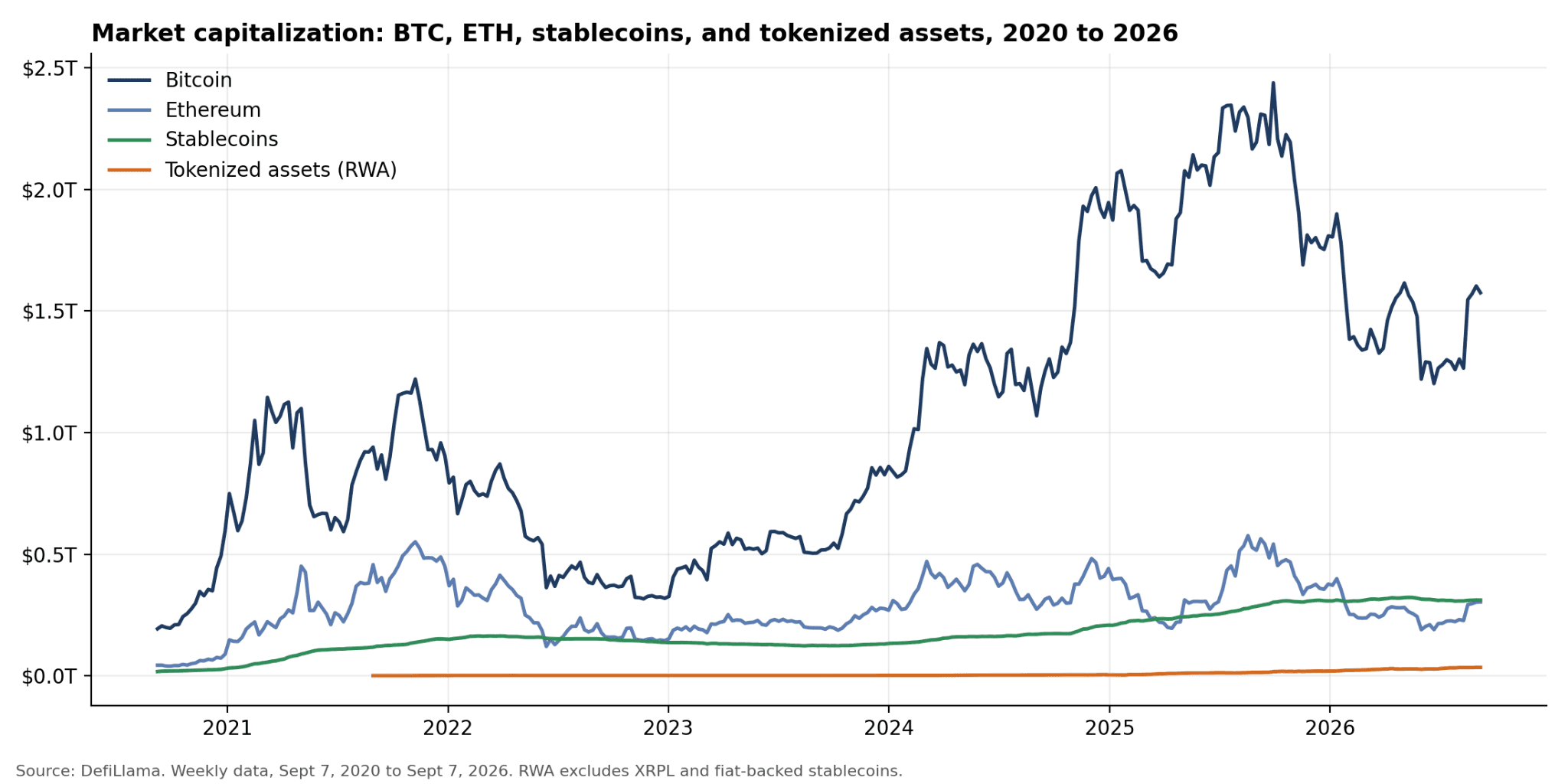
In earlier cycles, as stablecoin lending rates dropped alongside falling leverage demand, capital moved off-chain to find yield. Sourcing returns from outside crypto gives stablecoin holders an incentive to remain on-chain during rate declines, helping lending markets, liquidity pools, and settlement layers maintain the depth they need across market cycles. As shown in Chart 1, stablecoin and tokenized asset supplies continued to expand throughout the 2022 drawdown even as total crypto market capitalization contracted.
These external return drivers are imported directly into on-chain strategies as prices and interest rates. As a result, interest rates, credit spreads, and corporate earnings function as macro signals for on-chain positioning, rather than relying solely on the crypto cycle. This enables DeFi to attract allocators with macro mandates, significantly expanding its institutional capital base.
Access to Credit on Real-World Exposures
Tokenized credit products, from private credit funds to trade finance and specialty lending, pay higher rates than Treasuries while carrying lower volatility than crypto collateral. Before tokenization, leverage on these exposures reached only a narrow set of institutional participants through bilateral arrangements. On-chain, the same exposures can be posted as collateral in a lending market that any approved participant can access, with terms set by the market and settlement handled by the protocol.
When collateral yields more than the cost to borrow against it, on-chain credit demand shifts. Borrowing against tokenized credit can clear at higher interest rates than against ETH, because the asset's yield covers loan costs under a broader range of market conditions. These higher clearing rates attract stablecoin liquidity into lending markets, deepening available capital across the entire ecosystem.
Composability ties these mechanisms together: allocators can combine a tokenized credit position, a stablecoin borrow, and a yield strategy into a single structure tailored to their specific risk-return profile and adjust it position by position. Neobanks and fintech platforms are using these building blocks to create customized yield products for users, though the same tools are equally accessible to institutional funds, corporate treasuries, and individual investors. Together, credit access and composability transform tokenized assets from static holdings into active drivers of on-chain activity.
Chart 2 shows how much room that activity has to grow: of the $34.2 billion of tokenized assets on-chain as of September 2026, Treasuries and bonds account for $19 billion. Private credit holds $3.8 billion and public equity $3.3 billion, the latter up from $145 million a year earlier. The mechanism described here applies to the categories that remain small relative to Treasuries, which is where the growth in on-chain borrow demand from tokenized assets will come from.

How Tokenization Rewires On-Chain Markets
Institutions bring these assets on-chain to finance, deploy, and transfer them without selling. Our articles on how tokenized stocks work and what changes when a security is tokenized explore these mechanics in detail.
For DeFi, the conditions attached to tokenized assets reshape the market in three fundamental ways.
Two Layers of Permission
Tokenized securities carry transfer restrictions enforced in the token contract, which limits holding to approved addresses and leaves the issuer to decide whether protocol contracts are among them.
As a result, a permissioned layer of assets, pools, and vaults develops alongside the permissionless baseline. These layers meet at specific integration points, such as when a permissioned collateral asset is used to borrow a permissionless stablecoin or when a structured product packages gated exposure into a freely transferable token.
Different asset classes will introduce varied permission structures, some admitting any lending market, others restricting access to whitelisted venues, and the strictest limiting it to verified investor wallets. The precise nature of this convergence will ultimately depend on the specific asset class and applicable regulations.
Liquidity in the Primary Channel
Tokenized assets have not formed deep DEX markets, so their liquidity sits in the mint and redeem channels operated by the issuer, with secondary trading as a thin layer above. As a result, three key mechanics that DeFi relies on must change:
Liquidation. A liquidator can no longer assume a pool to sell into, so recovery runs through whitelisted liquidators, redemption as a backstop, or issuer buyback.
Pricing. A continuous market price is no longer available, so valuation runs on NAV feeds, off-chain reference prices, and oracle designs built for stale marks and market-hours gaps.
Depth. Pool size stops being a measure of depth, which is read instead from redemption capacity and the terms attached to it.
Openness Exchanged for Scale
DeFi trade-offs part of its permissionless nature to gain access to real-world assets that do not depend on crypto prices.
However, this shift applies unevenly. Where the asset itself requires no access controls, the permissionless layer operates as usual: covering stablecoin credit, crypto collateral, and their derivatives. In contrast, the permissioned layer expands when underlying assets must comply with securities regulations.
Ultimately, combining both layers creates a larger and more resilient system than relying solely on pure crypto assets.

The assets have arrived and integration into on-chain credit and strategies has started. The pace of that work now depends on the risk analysis required to do it at scale.
How Risk Frameworks Evolve
A DeFi risk framework built for crypto collateral asks a bounded set of questions: contract security, oracle integrity, liquidation parameters, pool depth, and the correlation between collateral and debt. Every one of them still applies.
Tokenized assets introduce two additional layers of risk that modern frameworks must evaluate.
The first layer requires traditional financial analysis of the underlying asset: evaluating the issuer's solvency, the legal force of the tokenized claim, custodian security, redemption mechanisms, and how the asset responds to interest rate or credit shocks. While these represent established TradFi disciplines, bringing them into on-chain risk assessments requires integrating traditionally siloed analytical processes.
The second layer focuses on the complex interactions between traditional and decentralized financial systems; a domain where established methodologies are still emerging:
How is a legal claim on an off-chain asset enforced when the on-chain position is liquidated?
What happens to a lending market when an issuer gates redemptions on the same day that crypto collateral is being sold?
How does an oracle behave when the reference market is closed and the on-chain market is open?
How does liquidity fragment when the same asset exists in a permissioned pool and a permissionless one, and how does a shock in one reach the other?
Every framework in use today stops at the boundary between the two, which is exactly where these questions sit.
Risk frameworks will increasingly evaluate entire strategies across both on-chain and off-chain environments. This requires changes across key areas: collateral analysis must evaluate issuer and custodian concentration alongside oracle design; liquidity analysis must assess redemption terms alongside pool depth; stress testing must combine interest rate, credit, and crypto market scenarios; and strategy evaluation must price the legal and operational path from on-chain positions to off-chain recovery.
Frameworks that adopt this unified approach can support credit backed by tokenized assets at scale, whereas those that do not will keep tokenized assets limited to static holdings.
Sentora's risk framework is built for that boundary. The vaults we curate are where it meets live capital.