A tokenized stock is simple to describe: a share sits with a custodian, a token representing that share moves on a blockchain, and the holder gains exposure to a listed company without a brokerage account. The description holds until a buyer asks the first serious question: who owns the underlying share, and what does the token holder have a claim on?
The answer depends on structure. Three issuance models operate in production today. Each one places the holder in a unique legal position, treats dividends and voting rights differently, and produces a different outcome if the issuer fails. Two tokens tracking the same share price can carry claims that behave nothing alike in a default, and the difference is invisible from the ticker.
Issuance itself has stopped being the constraint on this market. Regulated custodians hold the shares, supervised issuers run the wrappers, and the largest venues in traditional finance are building equivalent rails inside their own infrastructure. Market focus has evolved beyond the mechanics of issuance to the strategic value of tokenized assets. Investors are now positioned to unlock significant economic opportunities, capturing market upside while retaining their underlying exposure.
This article covers the mechanics that determine those opportunities. It sets out how the three issuance models differ, who occupies each role in the custody chain, how corporate actions are handled, what settlement genuinely improves, and where the regulatory perimeter sits.
How Do Tokenized Stocks Work?
A tokenized stock is a blockchain token whose value is tied to a share in a publicly listed company. The token is created, or minted, when an issuer establishes the link between the on-chain record and the underlying asset. The token is destroyed, or redeemed, when that link is unwound.
Share tokenization changes the record of exposure rather than the nature of the asset. The listed company continues to operate under the same reporting obligations, and the underlying share continues to sit inside the traditional custody chain. What changes is the format of the claim held by the investor and the venues where that claim can move.
Three structures dominate the market, and the differences between them determine what a holder owns, what rights travel with the token, and what happens if the issuer fails.
Ready to look beyond the mechanics? Discover the next phase of tokenized finance, from yield to collateral, in our exclusive webinar: Beyond the Wrapper: What Tokenized Assets Do Next.
The Three Issuance Models
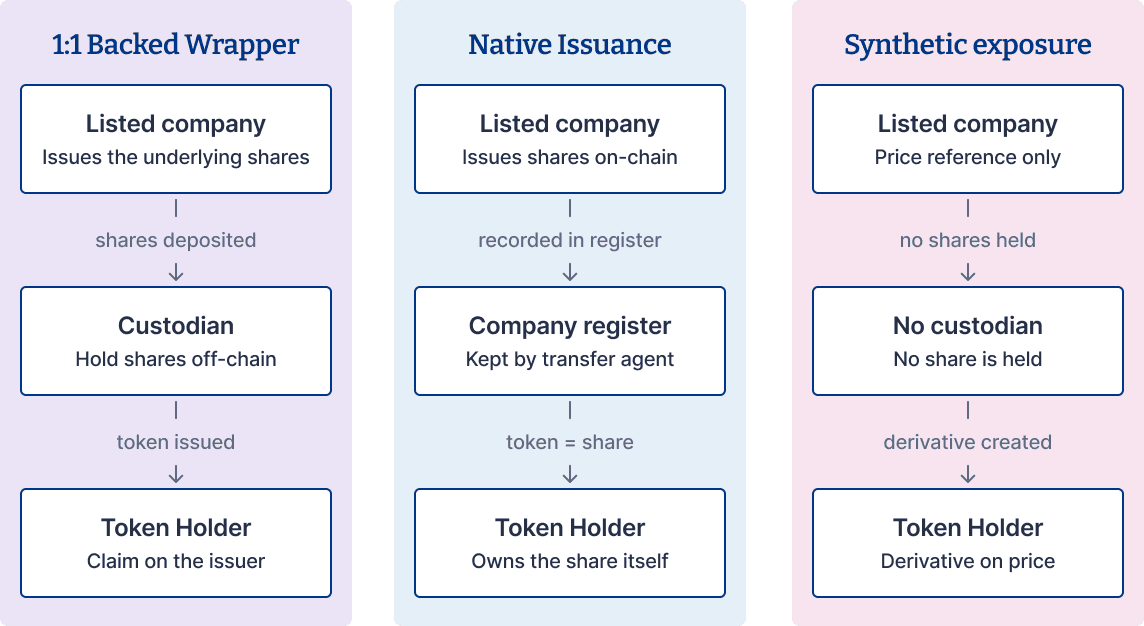
Model | What the holder owns | Who holds the underlying share | Representative issuers |
|---|---|---|---|
1:1 backed wrapper | A contractual claim on the issuer, backed by shares held in custody | A regulated custodian appointed by the issuer | Backed Finance (xStocks), Ondo Global Markets, Dinari |
Issuer-led native issuance | The share itself, recorded on-chain in the company register | The company register, maintained by a registered transfer agent | Securitize, Figure |
Synthetic exposure | A derivative position referencing the share price | No underlying share is held | Perpetual futures venues, on-chain price-referenced products |
1:1 Backed Wrappers
This model accounts for the large majority of tokenized stock trading today. An issuer buys the underlying share on a traditional exchange, places it with a regulated custodian, and mints a matching token on-chain. Redemption reverses the sequence.
The legal wrapper varies by issuer and jurisdiction. Backed Finance issues xStocks under a Liechtenstein prospectus supervised by the FMA, with custody at institutions including Clearstream Banking and InCore Bank. Ondo Global Markets uses a different construction: each token is a structured note, a debt instrument issued by Ondo Global Markets (BVI) Limited, a bankruptcy-remote special purpose vehicle, with holder rights governed by Swiss law and 1:1 backing plus a buffer held through a regulated custodial broker-dealer.
Both structures deliver economic exposure to the share price. Neither makes the holder a registered shareholder of the listed company.
Issuer-Led Native Issuance
Here the company issues its own shares directly on-chain, and the token is the share rather than a claim on one. The register is maintained by a transfer agent, which gives the holder the legal standing of a registered or beneficial owner, including voting rights and dividend entitlement.
Figure and Securitize have both issued their own equity this way. The model has expanded into the wider market: Intercontinental Exchange partnered with Securitize during 2026 to build tokenized equity infrastructure, and Continental Stock Transfer and Trust selected Securitize as its preferred tokenization provider in late June 2026, which extends the issuer-direct route to a much larger base of public and private companies.
The constraint on this model is participation. It requires the issuing company to act, so coverage grows company by company rather than ticker by ticker.
Synthetic Exposure
Synthetic products reference the share price without holding the share. The holder carries exposure to price movement and a claim against the counterparty or protocol rather than against any asset. Volume in this segment is substantial, with RWA perpetual futures recording $524.79 billion in trading volume during Q1 2026 according to CoinGecko, and the structure serves traders rather than allocators seeking the underlying asset.
The first tokenized equity cycle in 2018 relied heavily on synthetic construction and failed to hold liquidity. The second wave converged on full collateralization, which is the decisive structural difference between the two periods.
The Custody Chain From Share to Token
Every backed token depends on a chain of named institutions. Understanding who occupies each role is the substance of diligence on any tokenized stock programme.
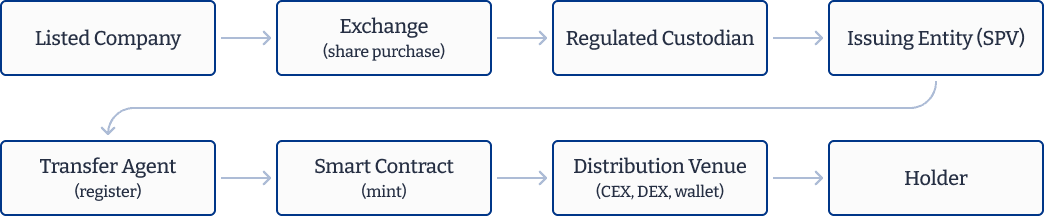
The issuing entity creates the token and owes the obligation to the holder. Its jurisdiction, capitalisation, and bankruptcy remoteness set the recovery position if the structure fails. An SPV organised in the British Virgin Islands and a Swiss issuer operating under a Liechtenstein prospectus place the holder in materially different positions.
The custodian holds the underlying share. Custodian quality, audit cadence, and segregation of client assets determine whether the 1:1 backing is enforceable in practice rather than only on paper.
The broker-dealer executes purchases and redemptions in the traditional market and, in the newer US-facing structures, enforces transfer restrictions at the point of execution.
The transfer agent maintains the ownership register. This role is the dividing line between the two backed models. In issuer-led issuance, the transfer agent records the token holder. In wrapper structures, the transfer agent records the issuer or its custodian as the shareholder, and the token holder appears nowhere on the register.
The distribution venue and the chain determine reach and composability. Ondo distributes across multiple networks and wallet integrations, xStocks settle primarily on Solana with Ethereum deployments, and Dinari issues on Ethereum, Arbitrum, Base, and Plume. Chain selection governs which lending markets, exchanges, and vaults the token can enter, which is the variable that matters most for anything the holder wants to do beyond holding.
The Securities Transfer Association raised this distinction with the SEC in July 2026, arguing that regulators should draw a clear line between issuer-sponsored tokenized securities and third-party stock tokens, on the grounds that only the former represent shares authorised by the company and recorded in its official register.
Dividends, Splits, and Voting Rights
Corporate action handling follows directly from the issuance model.
Corporate action | 1:1 backed wrapper | Issuer-led native issuance | Synthetic exposure |
|---|---|---|---|
Cash dividends | Economic value passed through, by rebasing the token balance, adjusting an on-chain multiplier, or distributing stablecoins, net of withholding tax | Paid to the holder of record in the same manner as any registered shareholder | Reflected in the reference price or funding, with no distribution |
Stock splits | Token supply or exposure multiplier adjusted pro rata by the issuer | Register updated, holder position adjusted directly | Reference price adjusted |
Voting | Not passed to holders in current programmes. The custodian votes the shares under its standing policy or abstains | Full voting rights attach to the token | No voting rights exist |
Elective actions (tender offers, mergers) | Handled case by case under the prospectus, generally by passing economic value rather than offering a holder election | Holder elects, as a registered owner | No election available |
The gap on voting is consistent across live wrapper programmes. Kraken states plainly that xStocks confer no shareholder rights and pass through the economic benefit of dividends rather than paying cash. Ondo's documentation describes tokens designed so that value changes with the underlying asset, including corporate actions. Withholding tax applies before value reaches the holder, and a 30% US withholding deduction on dividends before reinvestment is standard practice on distribution venues.
One structure in particular closes this gap: Ondo's US-custody model uses Broadridge to extend shareholder communications, proxy materials, and voting to token holders through existing investor services infrastructure, alongside a licensed transfer agent and enforcement of transfer restrictions across broker-dealer, transfer agent, and custody roles. The direction of travel is toward parity with registered ownership, and other products have not arrived there yet.
Tokenized assets are moving from experiment to institutional infrastructure. Learn how to evaluate the governance, risk controls, and custody frameworks that underpin sustainable on-chain allocation. Access our exclusive webinar: Beyond the Wrapper: What Tokenized Assets Do Next.
What Settlement Improves
US equity settlement runs on T+1, supported by central clearing and multilateral netting. Tokenized stock transfers settle on-chain in seconds, continuously, and without a clearing intermediary. The comparison is narrower than it first appears, and precision here matters more than enthusiasm.
Three things genuinely improve:
Secondary transfer finality moves from a one-day cycle to near-instant, which removes counterparty exposure during the settlement window and supports delivery against payment in a single atomic transaction.
Collateral mobility improves in the same step, because a settled token can be pledged immediately rather than after the settlement cycle completes.
Transferability becomes continuous, so positions can move outside market hours and across borders without a broker as intermediary.
Three things do not improve, and each carries a cost:
Netting efficiency declines under trade-by-trade atomic settlement, because the liquidity and balance sheet savings created by netting offsetting flows through a central counterparty are lost. The practical consequence is higher gross funding requirements.
Primary issuance and redemption still ride traditional settlement, so the underlying share purchase remains a T+1 event whatever happens on-chain.
Price formation outside market hours remains thin, because tokens trade continuously while the underlying market is closed, which produces divergence between token price and last traded share price.
The institutional response is to bring tokenization inside existing market structure rather than around it. In that model, the token represents legal ownership inside a regulated depository holding assets already in DTC custody.
The Question Issuance Does Not Answer
The mechanics above describe a category that has solved its first problem. Shares can be brought on-chain, held in regulated custody, transferred in seconds, and traded around the clock. Every one of those capabilities describes what happens when a holder wants to move or sell a position.
None of them describes what a holder can do while continuing to hold it. That is the question the market has not yet answered at scale, and it is the one that determines whether a token share is worth more than the share it represents. Borrowing against a position, hedging it, and generating a return on it all require the token to function as collateral inside on-chain credit markets, which depends on liquidation design, oracle reliability, and liquidity depth rather than on issuance or custody.
Sentora works on exactly that layer, as strategy and risk curator for tokenized equity markets and with more than $2 billion in capital deployed across on-chain strategies.
Sentora Co-founder Jesus Rodriguez, joined by Katya Ternopolska, VP of Sales and Partnerships, and Lucas Outumuro, VP of Institutional DeFi, takes this up in Beyond the Wrapper: What Tokenized Assets Do Next. They discuss what it takes for equities to function as productive collateral for borrowing, hedging, and yield. The session also covers how liquidation, oracle, and liquidity risk are solved at scale, and where the tokenised asset market is heading across Treasuries, credit, and gold.