
Where Yield Comes From
The Kraken Bitcoin Vault converts idle BTC holdings into a structured yield position by deploying assets into vetted DeFi protocols, without requiring any active management from the depositor.
The vault operates through a supervised loan strategy. BTC assets are supplied as collateral to vetted lending protocols. The vault then borrows against that collateral, typically stablecoins, and deploys the borrowed capital into a pre-selected set of yield opportunities where expected returns exceed borrowing costs.
Those secondary yield opportunities include:
Onchain Lending Markets: Providing the borrowed stablecoin capital to money markets (Aave, Euler, Morpho), where borrowers pay interest to access liquidity.
Real World Assets (RWAs) Allocating to high-quality yield-bearing assets that generate their own sustainable internal return.
Market Neutral AMM Pairs: Supplying assets to Decentralized Exchanges like Curve to facilitate trading in exchange for transaction fees.
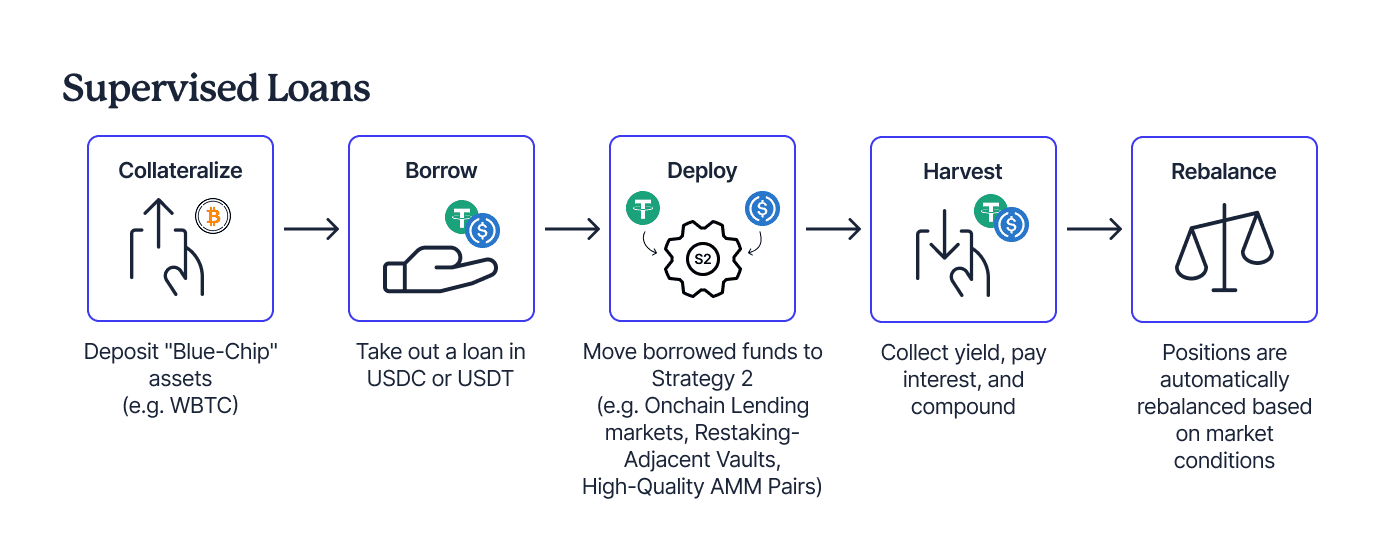
The goal is to make BTC collateral more productive. The vault is not engaged in directional speculation or margin trading. Yield is generated from the spread between borrowing costs and the returns on deployed stablecoins.
On Leverage: Why It Is Used and How It Is Constrained
Leverage is the most common source of concern among new depositors, and it is a reasonable one to raise. The answer is clearest when framed against the alternatives.
Without leverage, producing meaningful yield on BTC requires taking directional risk. The most common unleveraged approach is to supply BTC into a DEX liquidity pool alongside another volatile asset. In that setup, the vault's returns depend on whether Bitcoin's price moves in a predictable direction relative to the paired asset. It does not. Bitcoin's price is inherently difficult to forecast, which means impermanent loss in such a position can become permanent quickly. That is a harder risk to manage than the leverage risk in a supervised loan.
The supervised loan approach uses leverage to remain market neutral. The vault borrows stablecoins against BTC collateral and deploys them into stablecoin yield strategies. The position does not express a directional view on BTC price. If BTC appreciates, the collateral position improves. If BTC depreciates, the vault's automated systems deleverage before liquidation thresholds are approached.
Sentora's use of leverage in this vault differs meaningfully from the high-risk leverage common in centralized exchange margin trading:
CEX Margin Trading | Bitcoin Vault Supervised Loan | |
Goal | Amplify directional price exposure | Capture yield spread on deployed stablecoin capital |
Market neutrality | No | Yes |
Liquidation driver | Price moves against directional bet | BTC depreciates faster than the vault can rebalance |
Leverage multiple | Often 5x–100x | Constrained; 10–20% buffer below max collateral ratio |
Risk management | Manual or exchange-automated | ntinuous, with autonomous deleveraging |
This mechanism has operated across more than three years of live deployment, including through volatile periods like October 2025 and the August 2024 yen carry trade unwind, with $0 in liquidations.
No Recursive Leverage
A related concern is whether the vault uses recursive leverage, sometimes called looping, where a depositor supplies an asset, borrows against it, re-deposits the borrowed amount, borrows again, and repeats across multiple cycles.
The Bitcoin Vault does not use recursive leverage. The supervised loan structure is a single-cycle borrow: BTC collateral is deposited once, stablecoin is borrowed once, and the borrowed capital is deployed into approved yield strategies. The second leg of the strategy generates yield through stablecoin lending markets and other approved venues. It does not feed back into a BTC loop.
This distinction is important because recursive leverage on BTC would compound exposure to BTC price movements across each cycle. The single supervised borrow does not. The vault's leverage is constrained to one cycle, carries defined exposure limits, and is governed by automated rebalancing at all times.
On kBTC: The Wrapper and What It Means for Depositors
Depositors who hold Bitcoin directly may observe that the vault holds collateral in the form of kBTC rather than native BTC. This is worth addressing clearly.
kBTC is Kraken's wrapped Bitcoin token on Ethereum. It is redeemable one-to-one for Bitcoin, with no fees. The wrapping is a technical necessity: native Bitcoin does not operate on Ethereum, and accessing Ethereum's deep liquidity pools, lending markets, and yield venues requires an ERC-20 representation of BTC. kBTC is that representation.
For depositors who are already Kraken users, the trust relationship here is not new. Holding Bitcoin on Kraken already involves trusting Kraken with custody of those assets. The kBTC wrapper extends that existing relationship to enable onchain deployment, with the added transparency of Ethereum's public ledger. Kraken publishes clear documentation on how kBTC works and how it can be redeemed, and positions within the vault are fully traceable on-chain in real time.
The wrapper does not introduce additional custodial risk beyond what a Kraken user has already accepted. What it does add is access to the full depth of Ethereum's DeFi infrastructure, which is what makes the yield strategy possible.
The Three Layers of Risk Management
Sentora uses a defense-in-depth model. Since implementing our risk monitoring layer in January 2021, Sentora has managed positions through severe market downturns without losing client principal. The Bitcoin Vault operates under the same framework.
Layer 1: Research and Due Diligence
No capital is allocated without a formal review by the Research Team. We have vetted 60+ protocols across 17+ networks.
Technical Risk: Deep review of audit history, codebase provenance, and bug bounties.
Economic Risk: Assessment of bad debt risk, de-peg scenarios, revenue sustainability, liquidation mechanics, and oracle dependencies.
Counterparty and Operational Risk: Review of team backgrounds, multisig configurations, and admin key management to identify centralization vectors.
Layer 2: Automated On-Chain Triggers
Sentora's infrastructure connects with Veda's BoringVault to provide an autonomous risk layer that operates as a 24/7 circuit breaker.
Collateral Ratio Monitoring: The system continuously tracks collateral ratios, borrow costs, and liquidation thresholds. Positions are structured with a 10–20% buffer below maximum borrowing capacity.
Autonomous Deleveraging: If BTC collateral depreciates or on-chain signals breach safety thresholds, the vault can automatically recall capital from approved strategies and repay debt before liquidation thresholds are reached, within the same block if necessary.
Liquidation Prevention: The system deleverages positions automatically before a Health Factor reaches a critical level. The vault has recorded $0 in liquidations across more than three years of live operation.
Layer 3: Quantitative Off-Chain Monitoring
Active oversight tracks metrics across six major risk categories: Concentration, Liquidity, Interest Rate, Duration, Leverage, and Correlation. Key metrics include:
Val01: Sensitivity of portfolio value to a 1 basis point change in interest rates.
Exit Maturity: A stress test determining the worst-case timeframe to fully exit a position without excessive slippage.
Available Liquidity: Evaluation of whether a pool has sufficient depth for the vault's position to exit cleanly.
Concentration: Tracking of large-holder movements that could affect market conditions.
Operational Safeguards and Security
Sentora adheres to a "return of capital before return on capital" philosophy.
Non-Custodial Architecture: All Sentora vaults are non-custodial. In the Kraken Bitcoin Vault, each deposit is managed through Veda's BoringVault infrastructure. When you deposit, only you retain the right to withdraw your assets. Sentora can only rebalance funds between pre-approved, whitelisted protocols. It cannot transfer funds to unauthorized addresses.
Independent Audits: The vault infrastructure has undergone multiple independent audits by Spearbit and 0xMacro, two of the most reputable firms in DeFi security.
No Arbitrary Lockups: Withdrawals are available through a standard five-day withdrawal period, which allows the system to facilitate exits across multiple strategies while minimizing slippage costs. This window is expected to compress over time as the vault scales and deposit flows deepen
Conclusion
The guiding principle behind every decision Sentora makes is simple: return of capital before return on capital. The Bitcoin Vault is designed to put idle BTC to work through a structured, constrained, and continuously monitored strategy.
Sentora will soon publish onchain data dashboards to support with verification of vault positions and flows.