Where Yield Comes From
In DeFi, yield is the return earned on deposited assets, generated through decentralized protocols. Sentora vaults produce yield through diversified, multi-source strategies that spread exposure across leading protocols and highly liquid assets, while prioritizing realized yield instead of points rewards or other illiquid yield mechanisms.
Lending Interest: Earned by providing capital to money markets (Aave, Euler, Morpho), where borrowers pay interest to access liquidity.
Liquidity Provision: Supplying assets to Decentralized Exchanges (DEXs) like Curve to facilitate trading in exchange for transaction fees.
Native Yield-Bearing Assets: Exposure to high-quality assets that generate their own internal yield, such as Ethena’s sUSDe or Maple’s syrupUSDC.
Auto-Compounded Incentives: Sentora’s smart contract layer automatically converts protocol incentive tokens into the base asset (e.g., USDC). This converts speculative token price exposure into "real" cashflow, compounded back into your initial deposit.
Yield Amplification
Sentora applies moderate leverage for certain strategies, using deposited assets as collateral to increase exposure within strict safety limits:
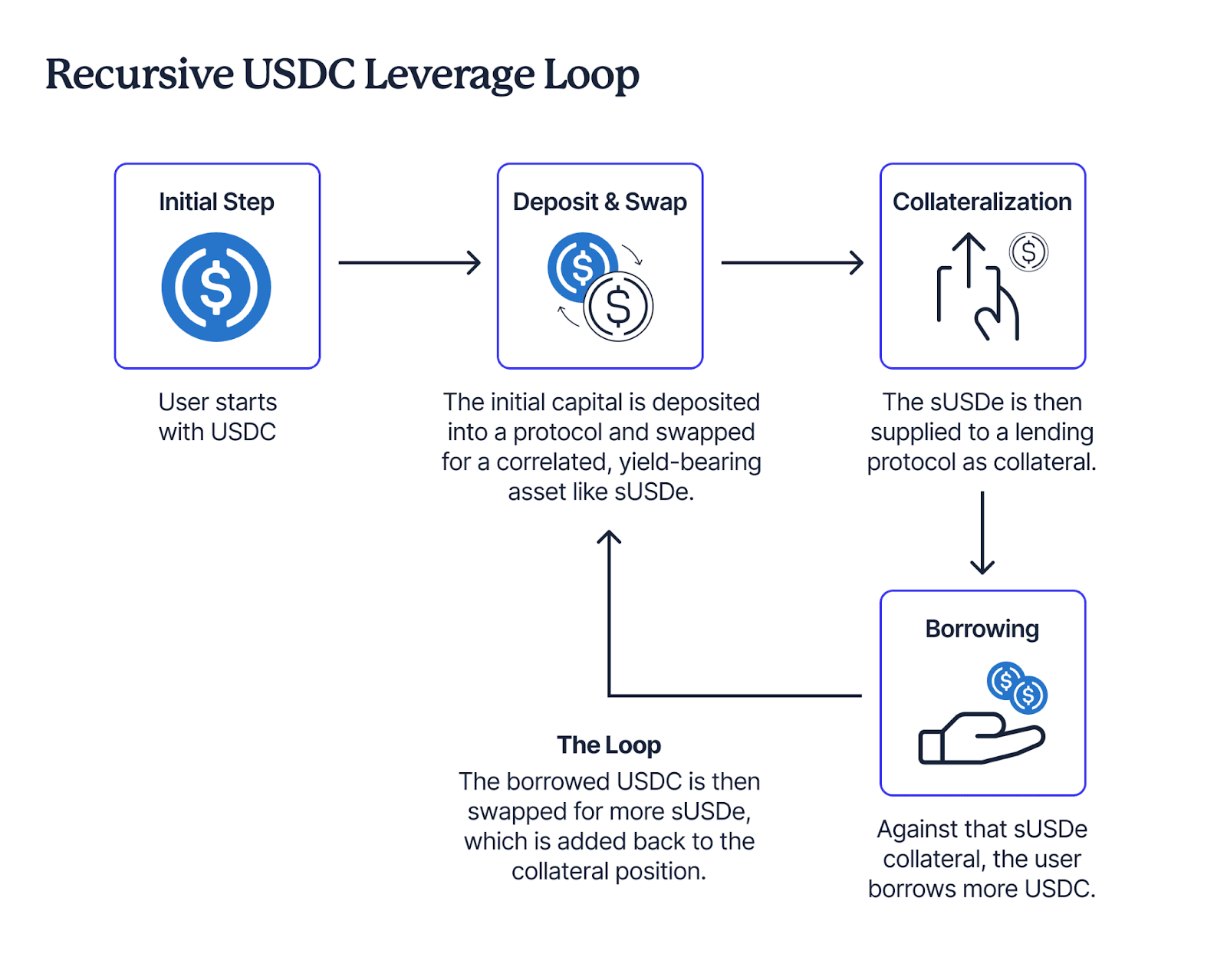
Leveraged Looping: Cycling between two highly correlated assets (e.g., looping sUSDe with USDC). This amplifies native yields and incentives while the high correlation minimizes the risk of price divergence. Learn more on Leveraged Looping
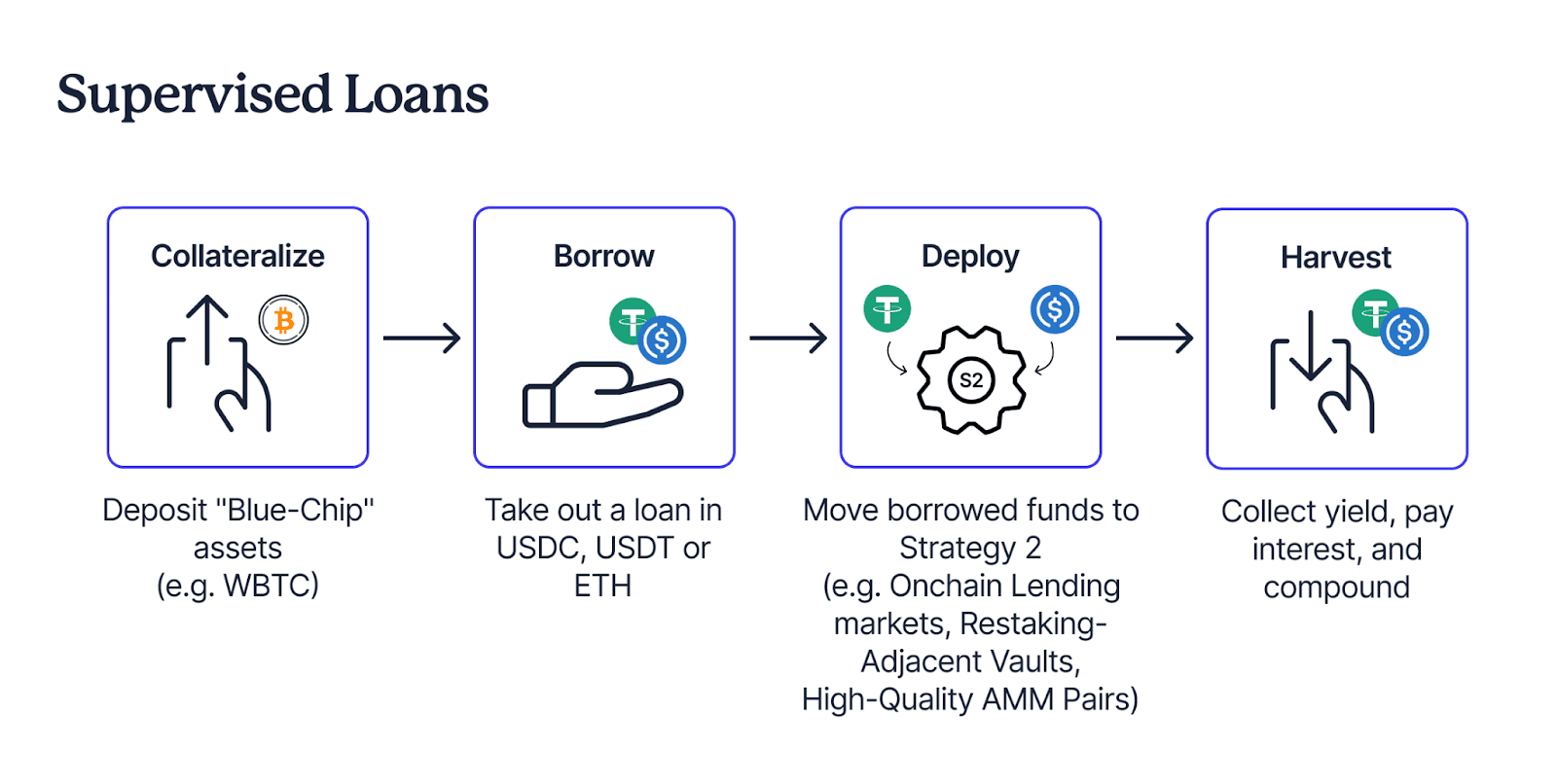
Supervised Loans: Supervised loans are used when dealing with lower-yield "blue-chip" collateral (like WBTC) , which are used to borrow assets with higher yield opportunities (like stablecoins). Learn more on Supervised Loans
Sentora’s use of leverage is designed to be structurally conservative and differs meaningfully from the high-risk leverage often seen in CEX margin trading. Rather than pursuing high multiples or directional bets, Sentora applies leverage in tightly controlled setups and avoids pairing uncorrelated assets, which is a common source of sudden drawdowns.
For both of these strategies mentioned above, Sentora bases the amount of safe leverage on a comprehensive risk framework.
The Three Layers of Risk Management
Sentora uses a "defense-in-depth" model. Since implementing our risk monitoring layer in January 2021, Sentora has successfully managed positions through severe market downturns without losing client principal.
Layer 1: Research & Due Diligence (Pre-Deployment)
No capital is allocated without a formal review by the Research Team. We have vetted 60+ protocols across 17+ networks.
Technical Risk: Deep-dives into audit history, codebase provenance, and bug bounties.
Economic Risk: Assessing bad debt risk, de-peg scenarios, revenue sustainability, liquidations and oracle dependencies.
Counterparty/Operational Risk: Reviewing team backgrounds, multisig configurations, and "admin key" management to identify centralization vectors.
Curation Role: In many markets (such as MetaMorpho or Euler), Sentora acts as the curator, directly controlling risk parameters like LTV, liquidation thresholds, and supply caps.
Layer 2: Automated On-Chain Triggers (Real-Time)
Sentora’s infrastructure plugs in with Veda’s boring vault to enable an autonomous risk monitoring layer that acts as a 24/7 circuit breaker.
Effective Rebalancing: The smart contract layer enables automated rebalancing to maintain optimal leverage ratios. By dynamically adjusting positions across whitelisted protocols, the system ensures that collateralization levels remain within safe bounds even during periods of market volatility, proactively protecting the Health Factor of every position.
Autonomous Disassembly: If on-chain signals such as sharp changes in liquidity, slippage, or market utilization breach safety thresholds, the system can autonomously unwind a position within the same block.
Liquidation Prevention: The system is designed to deleverage positions automatically before a "Health Factor" reaches a critical level, preventing forced liquidations.
Layer 3: Quantitative Off-Chain Monitoring (Continuous)
Active oversight tracks metrics across Six Major Risk Categories: Concentration, Liquidity, Interest Rate, Duration, Leverage/Looping, and Correlation. While our monitoring expands across dozens of metrics, examples of key metrics include:
Val01: Sensitivity of the portfolio value to a 1 basis point change in interest rates.
Exit Maturity: A stress-test determining the worst-case timeframe to fully exit a position.
Concentration: Tracking "whale" movements and large-holder concentration.
Available Liquidity: Evaluating if a pool has sufficient depth for our position to exit without high price impact.
Operational Guardrails & Security
Sentora adheres to a "return of capital before return on capital" philosophy:
Non-Custodial Architecture: All Sentora vaults are non-custodial. In the case of the Kraken DeFi Earn vaults, each deposit is managed through Veda’s vault infrastructure. When you deposit, only you have the right to withdraw your assets. Sentora can only rebalance funds between pre-approved "whitelisted" protocols; it cannot transfer funds to unauthorized addresses.
Independent Audits: Our vault infrastructure has undergone multiple independent audits by Spearbit and 0xMacro, two of the most reputable firms in DeFi.
Kraken Advanced Strategy Vault: Key Data
While Sentora strategies sit behind each of the Kraken Earn vaults, we'll zoom in slightly on the advanced strategies vault; the one that utlzes the most sophisticated set of strategies and protocols. Sentora’s Advanced Strategy Vault in Kraken’s DeFi Earn program is designed to deliver competitive, risk-adjusted yield while maintaining strict controls around where assets can move, how positions are sized, and how leverage is managed. This section summarizes the most important details of the vault.
Current Exposure: Capital is deployed on Ethereum Mainnet and Ink, utilizing vetted protocols like Euler, Morpho, Curve, and Aave.
Strategies utilized: Simple lending, leveraged looping, and liquidity provisioning in DEXs
Risk controls: This vault operates under the same “defense-in-depth” risk framework described above: research gating before deployment, real-time on-chain triggers, and continuous quantitative monitoring.
Withdrawals: There are no arbitrary lockups. A standard one-day withdrawal period allows the system to facilitate large exits across multiple strategies while minimizing costs (slippage).
Net Yield: The APR shown in the Kraken and Krak front-end is the Net Rate. This accounts for all on-chain fees, protocol costs, borrowing interest, and slippage. What you see is exactly what the vault earns.
Transparency: As a DeFi-native solution, all funds are traceable on-chain. Users can verify positions in real-time through DeBank profiles or public Dune dashboards.
DeFi Protection: Sentora is actively developing protection options for both technical (smart contract exploit) and economic (market failure) risks. This additional cover product would add an additional layer of protection to users deploying into vaults.
Conclusion
The guiding principle behind every decision Sentora makes is simple: return of capital before return on capital. While the Decentralized Finance landscape offers unparalleled yield opportunities, it also introduces unique risks that traditional frameworks are often ill-equipped to handle.
Sentora has bridged this gap by combining institutional-grade research with autonomous, real-time technical safeguards. By maintaining a non-custodial architecture and adhering to a rigorous, multi-layered risk framework, we ensure that risk is not merely an afterthought, but a core component of our strategy. Our commitment remains to provide users with a secure, transparent, and highly managed environment for capital deployment in the evolving DeFi ecosystem.