Tempo is building toward a future where stablecoins move at institutional scale across applications, treasury systems, and payment rails. As these flows increasingly settle onchain, lending markets become a critical layer of infrastructure. Idle balances can be deployed productively, stablecoins can circulate more efficiently, and institutions gain access to transparent onchain credit markets.
Sentora is partnering with Tempo to support this next phase of institutional DeFi through curated vault infrastructure and active risk management. The new pathUSD vault is the first deployment under that partnership.
Tempo and the Next Phase of Stablecoin Infrastructure
Stablecoins are evolving beyond trading pairs and exchange settlement. Increasingly, they are becoming operational financial infrastructure for enterprises, fintech platforms, and onchain applications.
Tempo is positioning itself around this transition by building payment and settlement infrastructure designed for large-scale stablecoin usage. As institutional stablecoin adoption expands, the network has the potential to route substantial dollar-denominated flows across onchain markets.
That creates a natural demand for institutional-grade lending infrastructure.
Morpho's modular architecture allows lending markets to be configured with isolated parameters and specialised collateral frameworks. Rather than relying on shared risk pools, each market can be independently structured around the specific liquidity, volatility, and oracle characteristics of the assets involved.
Institutional Deployment on Tempo
As stablecoin activity on Tempo expands, Sentora's vault infrastructure and risk curation framework will support the development of additional lending and treasury strategies built on Morpho's lending rails.
The objective is to combine scalable stablecoin infrastructure, modular lending markets, and institutional-grade risk management into a framework capable of supporting large-scale onchain capital deployment. The pathUSD vault is the first step in that build-out.
“As institutions and fintechs increasingly adopt stablecoins, DeFi needs vault infrastructure designed for enterprise-scale earn programs, with transparent risk management and scalable lending markets at the core. Our partnership with Tempo is about building that foundation and enabling institutional capital to move onchain more efficiently.”
— Anthony DeMartino, CEO of Sentora
The PathUSD Vault
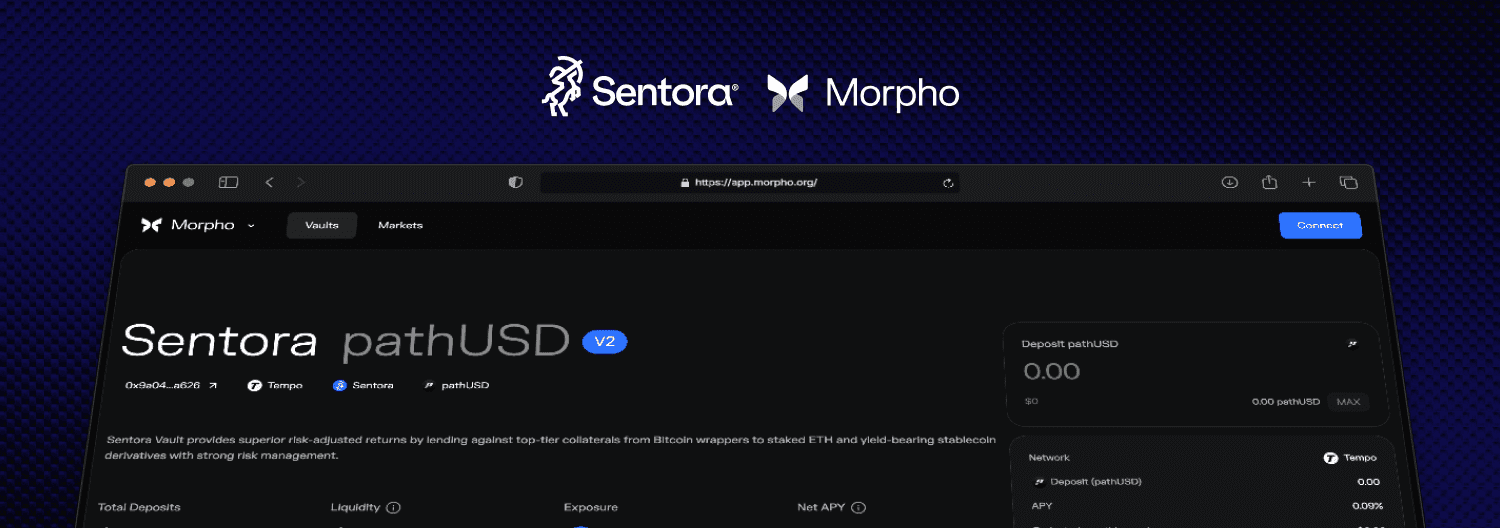
As part of this partnership, Sentora is launching a pathUSD vault on Morpho. The vault is the first concrete deployment of the collaboration, combining Tempo's stablecoin infrastructure with Sentora's risk curation framework on Morpho's lending rails. It lends pathUSD against cbBTC collateral through an isolated market configuration.
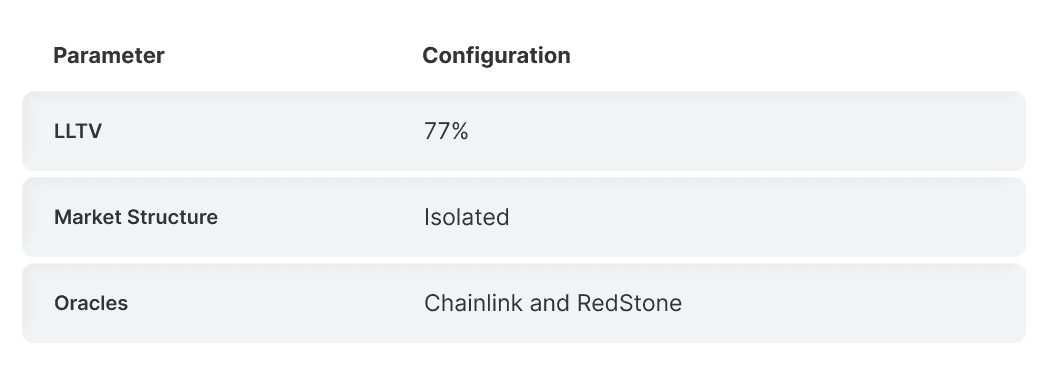
The market launches with conservative risk parameters:
Users deposit pathUSD into the vault. The vault deploys capital into the underlying Morpho lending market, where borrowers post cbBTC as collateral.
The isolated structure keeps risk exposure bounded to this specific market, rather than shared across unrelated collateral types or lending pools. This allows the vault configuration to be tailored to Bitcoin-backed borrowing activity and the liquidity profile of cbBTC.
Sentora acts as curator for the vault, responsible for configuring the deployment parameters of the market.
Risk Management
Sentora's vault curation operates within a structured risk framework built across seven categories: technical, concentration, liquidity, interest rate, duration, leverage, and correlation risk. Each deployment is assessed against this taxonomy before capital is allocated, and monitored continuously through Risk Radar, Sentora's proprietary risk management system.
For this deployment, this includes a specific focus on the behaviour and infrastructure surrounding cbBTC collateral. That includes assessing liquidity conditions, bridge design, oracle redundancy, and liquidation dynamics under stressed market conditions.
The 77% LLTV is a direct expression of Sentora's risk framework applied to this market. Lower leverage thresholds create a larger collateral buffer and reduce the probability of bad debt accumulation during periods of elevated volatility.
Oracle design is also a core component of the market structure. Chainlink and RedStone, two of the leading oracle providers in DeFi, supply the pricing infrastructure through a layered fallback architecture designed to improve resilience during market disruptions, oracle degradation, or periods of elevated volatility.