
Every tokenized asset class has the same three problems to solve. It needs a legal structure an institution can underwrite, a custody arrangement it can verify, and a reason for the token to exist rather than the conventional instrument. Treasuries solved all three first, and by a wide margin.
The category now sits at the centre of on-chain finance. A treasury token functions as the cash leg of institutional balance sheets, as margin at derivatives venues, as reserve backing inside credit protocols, and as the yield-bearing counterpart to payment stablecoins. That position was earned by a specific sequence, and the sequence is the transferable part.
This article covers why Treasuries scaled first, how the leading products are constructed, what the category looks like today, the collateral role that drove its growth, how the terms compare with a conventional money market fund, where tokenized bonds sit beyond government paper, and the concentration risk the growth has created. It closes on the lesson the category holds for every asset class still waiting for adoption.
Why Treasuries Scaled First
Short-dated government debt was the easiest asset to bring on-chain because it arrived with most of the hard problems already solved. The instrument is standardized and its price is transparent, which removes the valuation difficulty that stalls illiquid asset classes, and oracle design becomes straightforward when the underlying holds a stable net asset value near a dollar. That stable reference price is precisely what a lending market needs before it can accept an asset as collateral.
The wrapper existed too. Money market funds and short-duration bond funds are mature structures with established custody, administration, and transfer agency arrangements, so tokenizing a fund share meant adding a distribution channel to a working product rather than inventing an instrument. The regulatory perimeter followed from that maturity, since these products launched as permissioned securities sold to qualified investors under a conventional compliance model.
The demand side completed the picture. Crypto-native institutions, protocol treasuries, and trading firms were already holding large stablecoin balances that paid them nothing, and a tokenized Treasury fund converted that idle cash into a yield-bearing position without leaving the operating environment those holders already worked in.
How the Leading Products Are Built
Every product in this category resolves to a fund wrapper, a custody arrangement, and a redemption path. The differences across those three lines determine who can hold the token and how quickly a holder can exit.
Product | Wrapper and domicile | Record and administration | Yield mechanism | Redemption path |
|---|---|---|---|---|
BlackRock BUIDL | US institutional money market fund | Securitize as transfer agent, assets held at BNY Mellon | Daily accrual with a stable $1 target | Request through the Securitize portal, tokens burned at the next NAV strike, cash wired |
Circle USYC | Cayman-domiciled feeder fund holding Treasuries and overnight reverse repos | Permissioned share register, Circle operating the product after acquiring Hashnote | Price appreciation | USDC redemption rails operated by Circle, with near-instant conversion |
Franklin Templeton BENJI | US-registered mutual fund, FOBXX | Blockchain acts as the fund's official system of record | Daily accrual | Conventional fund redemption through the issuer |
Ondo OUSG and USDY | Feeder structure holding tokenized fund shares, and a separate yield-bearing note | Ondo, with underlying exposure including BUIDL for OUSG | Accrual or price appreciation depending on product | USDC redemption contract powered by Circle |
The wrapper in the second column decides the investor base, which makes it the most consequential line in the table. A Cayman feeder fund serves qualified non-US investors and US qualified purchasers, keeping the token away from retail wallets, while a US-registered mutual fund reaches a broader base under a different set of constraints. Neither structure is superior in the abstract, and the choice determines who a holder's counterparties will be. Franklin Templeton's FOBXX is worth noting on this point for anyone assessing how far the model has travelled, having been the first US-registered mutual fund to use a public blockchain as its official system of record.
Two further characteristics matter for anyone underwriting exposure here:
Products in this category reference each other, since OUSG holds BUIDL as underlying exposure, so an allocator holding one may carry indirect exposure to the other and should look through the wrapper to the assets rather than stopping at the issuer name.
USDC also serves as the cash leg across most of the category, because subscription and redemption for the major products run in it, which ties the yield layer to stablecoin infrastructure at the operational level.
Where the Category Stands
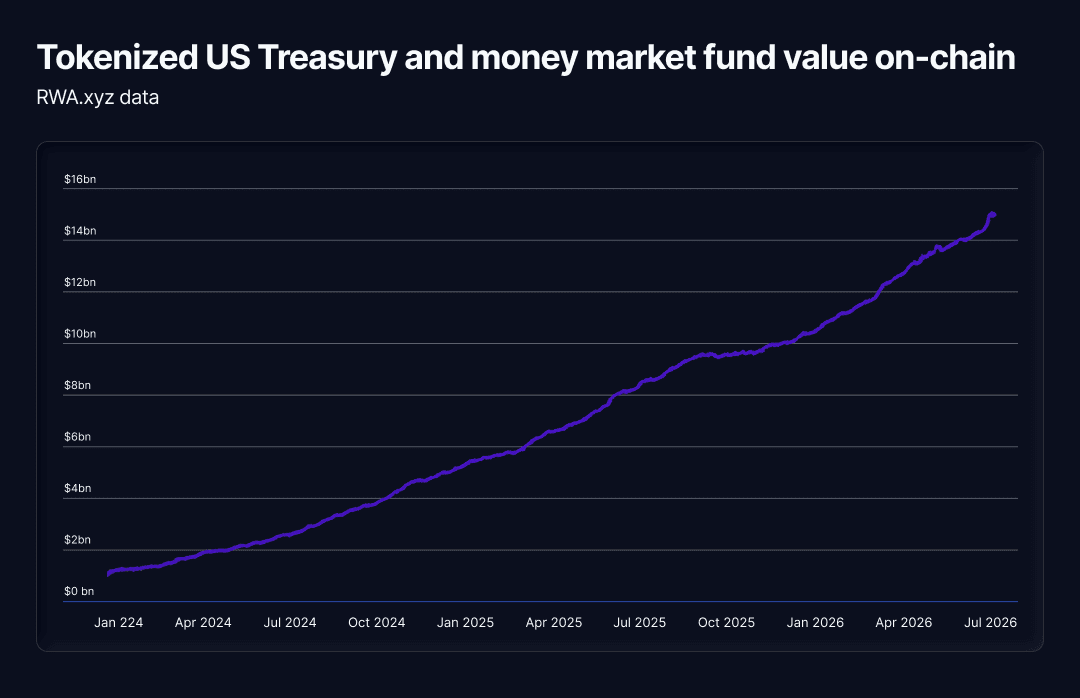
Tokenized Treasuries grew roughly 85% through 2025, moving from approximately $4.9 billion to around $9 billion, and crossed $10 billion in late February 2026 according to RWA.xyz. Reported levels for mid-2026 range between roughly $13 billion and $15 billion depending on the source and on whether tokenized money market funds are counted alongside direct Treasury exposure.
Five products hold the majority of that value:
Circle's USYC reached approximately $3 billion in assets under management and overtook BUIDL as the largest single tokenized Treasury product during the first half of 2026.
BUIDL holds roughly $2.5 billion and is live across nine networks.
Franklin Templeton's BENJI reached approximately $2.47 billion by late May 2026, with investor numbers up more than 140 percent between April 2024 and March 2026.
Ondo's USDY and OUSG add roughly $2.1 billion and $625 million respectively, and WisdomTree's tokenized fund sits in the next tier.
Treasuries remain the largest RWA category by value, ahead of private credit at around $8 billion, commodities at roughly $1.5 billion, and tokenized equities at a fraction of either.
The Collateral Role That Drove the Growth
The category's inflection point arrived when the token became useful to somebody other than its holder, and the clearest case is margin at trading venues. Binance accepts USYC as off-exchange collateral for institutional derivatives trading, with near-instant conversion into USDC, which lets a trading desk hold a yield-bearing position and post it as collateral at the same time. That removes the choice between earning a return on cash and keeping that cash available as margin, and much of USYC's growth has been attributed to the integration. It is also why the product's holder base became so concentrated.
On-chain credit markets followed the same logic. Sky holds more than $2 billion in real-world asset collateral with BUIDL among its primary assets, and BUIDL has been accepted as margin at institutional trading venues including Drift Institutional. A stable reference price is what makes any of this possible, because a lending market needs a reliable oracle and predictable liquidation behaviour before it can accept an asset at all.
The third use runs alongside stablecoin infrastructure rather than inside credit. Payment stablecoins are transactional instruments that pay their holders nothing, while a tokenized money market fund is a yield-bearing security with intraday settlement, so institutional treasurers use the first for movement and the second for parking. The redemption rails between the two are what make the pair work, and Circle's acquisition of Hashnote in January 2025 placed both legs inside one operator, with USYC and USDC flows moving through the same infrastructure.
The pattern holds across all of them. Value accrued to the category once the token could be used inside another system while the holder continued to hold it.
Like-for-Like Against a Money Market Fund
The honest comparison against a conventional money market fund shows advantages in mobility and gaps in access and depth.
Dimension | Conventional money market fund | Tokenized equivalent |
|---|---|---|
Yield | Determined by the underlying portfolio, less fees | Determined by the same portfolio, less fees, which are broadly comparable at institutional scale |
Subscription and redemption | Dealing cutoffs during business hours, settlement same day or next day | Official redemption still runs to a NAV strike and a cash wire, so the primary path retains a similar rhythm |
Transfer between parties | Limited to conventional channels, generally requiring redemption and resubscription | Continuous transfer between approved addresses, available outside market hours |
Use as collateral | Possible through established but slow-moving arrangements | Postable at supported venues and protocols, with conversion into stablecoins measured in minutes |
Access | Broad, depending on the fund | Restricted to qualified or accredited investors for most products, with minimums that can reach several million dollars |
Secondary market | Not applicable, since redemption is the exit | Emerging. Third-party windows have offered same-day exits at a small discount to NAV, and those windows sit outside the official redemption mechanism |
The material gain is mobility rather than yield. An institution that can move, pledge, or convert a cash position quickly needs to hold less idle balance against the possibility of needing it, which improves capital efficiency without changing the underlying return.
Tokenized Bonds Beyond Government Paper
The bond side of the category has followed a different route, driven by issuers and market infrastructure rather than by crypto-native demand.
These assets operate under two different models:
In native digital issuance the ledger is the legal register, which allows an issuer to remove the central securities depository from primary issuance.
In wrapper issuance a conventional bond exists off-chain and a token represents a claim on it, which preserves the existing intermediary chain.
Volume has been building on the native side. HSBC's Orion platform has supported more than $3.5 billion in cumulative digitally native bond issuance, including a $1.3 billion multi-currency green bond in Hong Kong, and it was selected in February 2026 to run the UK government's Digital Gilt Instrument pilot, the first native digital sovereign bond among G7 countries. Goldman Sachs has tokenized more than $700 million through GS DAP since its debut European Investment Bank issuance in 2022, and is opening that platform to the wider market. Société Générale issued the first digital bond by a bank in the US market in November 2025, a SOFR-linked floating rate note settled on the Canton Network.
The most instructive development is on the collateral side. In February 2026 a consortium including LSEG, Euroclear, DTCC, Tradeweb, Citadel Securities, and Société Générale completed the first cross-border intraday repurchase agreement using tokenized UK gilts on the Canton Network, including a leg in which gilts were repoed against tokenized deposits denominated in another currency, with haircuts and repo interest embedded in smart contracts. Participants described the exercise as part of a continuing test sequence rather than a production launch.
The constraint on tokenized bonds is the same one that limits every category at this stage. Secondary liquidity and on-chain cash availability lag the issuance capability, and most tokenized bonds are still held to maturity.
The Concentration Risk
Growth in this category has been concentrated in ways that a size figure conceals.
Holder concentration is the sharpest example. On-chain analysis in January 2026 indicated that a single institutional counterparty held approximately $1.43 billion of USYC, representing around 94 percent of its supply at that point. A product can be the largest in its category by assets while depending on one relationship. BUIDL showed a different profile at the same date with 103 unique holders, which is broader and still narrow in absolute terms.
Issuer concentration compounds it, since five products account for most of the category's value, and infrastructure concentration sits underneath both, because a small number of transfer agents and qualified custodians serve most of these programmes.
None of this is an argument against the category. It is an argument for looking through the headline number to the holder base, the custodian, and the redemption path before allocating.
The Lesson for Every Other Asset Class
Tokenized Treasuries did not scale because the token was easier to trade. They scaled because the token became useful inside other systems, as margin at a venue, as collateral in a credit market, and as the yield leg beside a payment stablecoin. Each integration created demand that had nothing to do with wanting to sell the position.
That is the sequence every other category has to run. Tokenized equities have solved issuance and custody, and the composable uses that made Treasuries indispensable are only now being built. Tokenized credit is following a similar path. The asset that wins in each category will be the one a holder can borrow against, hedge, and deploy while continuing to hold it.
Sentora Co-founder Jesus Rodriguez, joined by Katya Ternopolska, VP of Sales and Partnerships, and Lucas Outumuro, VP of Institutional DeFi, takes this up in Beyond the Wrapper: What Tokenized Assets Do Next. They discuss what it takes for equities to function as productive collateral for borrowing, hedging, and yield. The session also covers how liquidation, oracle, and liquidity risk are solved at scale, and where the tokenised asset market is heading across Treasuries, credit, and gold.