Most published comparisons of asset tokenization companies rank providers against each other in a single list. That format assumes the providers do the same thing, but they do not. An issuance and lifecycle platform, a custody and transfer agent provider, and a distribution venue occupy separate positions in the same transaction, and a buyer who evaluates all three against one checklist ends up with a vendor that solves the wrong problem.
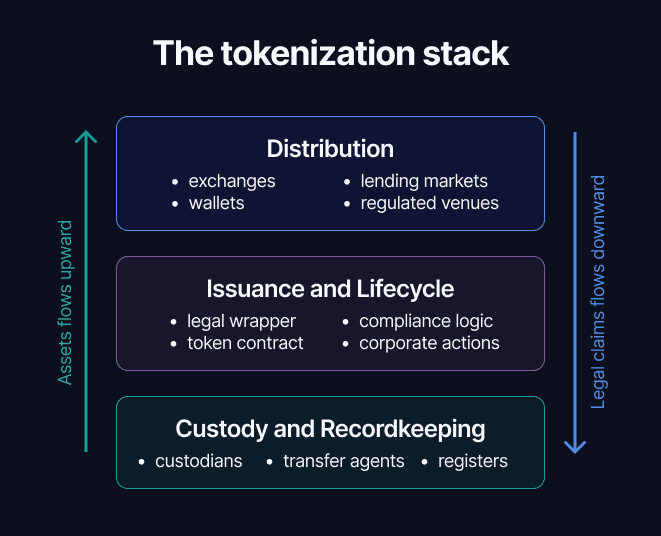
Tokenization has become a stack. Selecting an asset tokenization platform means deciding which layers to buy, which to build, and which counterparty holds the risk at each step. This article sets out the segmentation, the criteria that matter to a regulated buyer, and the two diligence areas that vendor comparisons routinely leave out.
The Three Segments of the Market
Segment | Function | Failure consequence | Representative providers |
|---|---|---|---|
Issuance and lifecycle platforms | Structure the legal wrapper, deploy the token contract, encode transfer restrictions, administer corporate actions | The token exists but its compliance logic or corporate action handling breaks | Securitize, Tokeny, ADDX, DigiShares |
Custody and transfer agent infrastructure | Hold the underlying asset, maintain the ownership register, process subscriptions and redemptions | Redemptions freeze and the backing becomes unverifiable | Securitize (SEC-registered transfer agent), Fireblocks, Taurus, Broadridge, Computershare, Continental Stock Transfer and Trust |
Distribution venues | Provide access, secondary trading, and integration into on-chain markets | The asset is issued and nobody can reach or use it | Kraken, Archax, tZERO, DTCC, Nasdaq, decentralized exchanges, on-chain lending markets |
Some providers span more than one layer. Securitize operates as both an issuance platform and an SEC-registered transfer agent, and it administers BlackRock's BUIDL fund in that dual capacity. Ondo Finance issues its own tokenized products while distributing them across multiple networks and wallet integrations. Vertical integration reduces coordination cost and increases concentration risk, which is a tradeoff to price rather than a feature to score.
The distinction that matters most sits at the boundary between issuance and distribution. RWA.xyz separates platforms that use a blockchain as a distribution layer, where on-chain investors subscribe, hold, and transfer through their own wallets or custodians, from platforms that use a blockchain as a recordkeeping layer, which improves reconciliation and transparency without enabling on-chain investor transfer. Both are legitimate tokenization mechanisms, but only the first produces an asset that can move inside on-chain markets, and the difference is invisible in a feature list.
The Criteria That Matter to a Regulated Buyer
Five variables determine the risk profile of any tokenized asset programme. Each one is answerable with documentation, and each has a specific failure mode.
Criterion | The question to ask | Evidence to require |
|---|---|---|
Legal wrapper | What instrument does the holder own, and what is the claim if the issuer fails? | Prospectus or offering document, fund regime, bankruptcy remoteness analysis |
Jurisdiction | Which regulator supervises the issuing entity, and which law governs holder rights? | Licence or prospectus approval, governing law clause, enforcement path |
Custodian | Who holds the underlying asset, under what charter, with what segregation? | Custodian identity and charter verified directly, attestation cadence, segregation model |
Chain support | Which networks does the token exist on, and which venues can reach it there? | Contract addresses, transfer restriction design, live integrations |
Redemption mechanics | How does the holder exit, on what timetable, and what happens under stress? | Redemption terms, cutoff times, gating provisions, wind-down path |
Two points on the legal wrapper deserve emphasis.
First, the instrument varies more than the marketing suggests, and the same asset class supports several structures. A tokenized equity position can be a structured note issued by a special purpose vehicle, a certificate issued under a European prospectus, or a share recorded directly on a company register through a registered transfer agent. Those three constructions put the holder in three different positions in a default. Identify the regime by reading the offering document rather than inferring it from the token standard or the issuer's reputation.
Second, custody concentration is the criterion most buyers underweight. A large share of tokenized fund assets currently sits with a small number of qualified custodians and transfer agents. Map that exposure the way you would map any concentrated counterparty, and establish whether a failure at one provider would freeze redemptions across an entire product line.
Why Chain Selection Determines Composability
Chain support reads like a technical detail on a vendor comparison. Yet, it is the defining variable that governs what the asset can do after issuance, and therefore what it is worth to the holder.
A tokenized asset becomes useful inside on-chain markets when three conditions hold at once:
The token must exist on a network where credit markets, exchanges, and vaults operate.
Its transfer logic must permit those contracts to hold and move it.
Sufficient liquidity must exist on that network to support price discovery and liquidation.
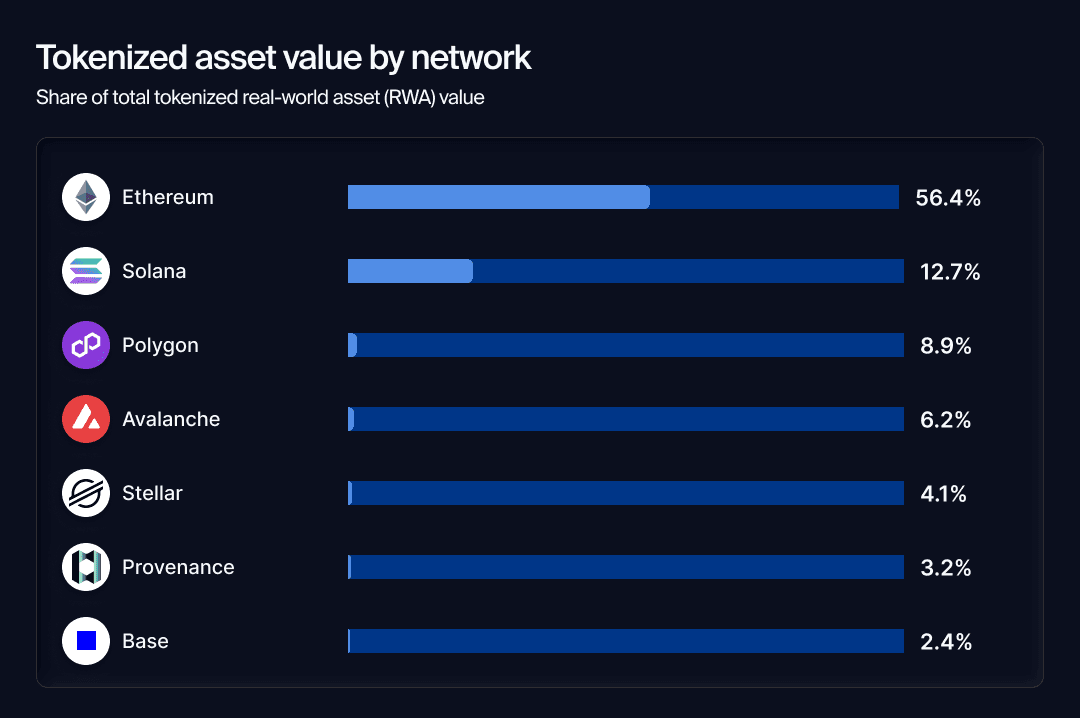
Ethereum satisfies all three for most asset classes and hosted more than 56% of all tokenized asset value as of April 2026 according to RWA.xyz, which is a function of where the lending markets and exchanges already are. Solana has established a second hub, growing from roughly $873 million in RWA value in early January 2026 to $1.66 billion by February, and it hosts tokenized equity issuance from Ondo Global Markets and Dinari alongside Backed's xStocks. Permissioned and purpose-built networks occupy a different position: Provenance holds approximately $1.3 billion in value, almost all of it Figure's tokenized home equity and consumer loan portfolio, which makes it deep in one category and closed to general composability.
Transfer restriction design sits alongside chain selection. Virtually every institutional tokenized fund enforces restricted transferability through on-chain whitelisting, so only addresses that have passed KYC and been approved by the transfer agent can hold the token. Standards such as ERC-3643 encode that logic into the token itself. This is the mechanism that keeps a tokenized security compliant, and it also determines which protocols can interact with the asset: a whitelist that admits only investor wallets excludes lending market contracts, while another designed to admit approved protocol addresses does not.
The direction of travel is toward permissioned composability rather than a choice between the two. BlackRock's BUIDL, with roughly $2.5 billion in assets under management and Securitize as transfer agent, began trading on Uniswap in February 2026, which placed a regulated institutional product on a decentralized exchange for the first time. Cross-chain deployments now account for more than 15% of the tokenized asset market.
Matching Platform Type to Asset Class
The right provider category follows from the asset and from what the holder is expected to do with the token.
Asset class | Platform type that fits | Reason |
|---|---|---|
Money market funds and Treasuries | Issuance and lifecycle platform with registered transfer agent capability | Daily NAV, subscription and redemption processing, and register maintenance dominate the workload. Tokenized money market funds represent over $3.6 billion in assets |
Public equities | Issuer-led issuance through a transfer agent, or a 1:1 wrapper issuer with a regulated custodian | Corporate action handling and shareholder rights depend on which of the two routes is used |
Private credit | Credit-specific infrastructure with per-pool legal structuring and originator integration | Underwriting, tranching, and default handling sit outside standard issuance tooling |
Commodities | Wrapper issuer with vault custody and independent attestation | Value depends on the credibility of the custody and redemption relationship rather than on the register |
Real estate | Issuance platform with SPV structuring capability, or debt-focused credit infrastructure | Valuation and oracle difficulty limit what the token can do beyond ownership recording |
Private funds and alternatives | Regulated marketplace or private market platform | Investor eligibility gating and periodic liquidity windows define the product |
Institutional readiness in one column does not transfer to another. A provider with strong fund tokenization credentials is not automatically the right choice for credit, because credit requires per-pool legal structuring and originator diligence that fund infrastructure does not perform.
The Two Diligence Areas Vendor Comparisons Omit
Secondary Liquidity, Described Honestly
Secondary trading is often described by vendors as a capability. For most tokenized assets today it is a roadmap item, and a realistic sequence runs in a specific order: primary issuance with broad distribution, collateral utility as the first active liquidity layer, programmatic redemption or over-the-counter dealing as the working exit, and exchange trading later, once investor base depth and market maker participation justify it.
Structure drives depth. Special purpose vehicle constructions that isolate the asset from the issuer's balance sheet have attracted the deepest order books in the category, because counterparties need confidence that their claim survives an issuer default before they commit sustained volume.
Three questions establish where a product actually sits:
Which venues quote the asset today, and what size trades there without moving the price?
Which market makers are contracted, on what terms, and do those commitments survive a stress period?
What collateral utility does the token have now, considering that in the current market structure, this is the liquidity layer available before an order book exists?
Redemption Mechanics, Tested Against Failure
Redemption is the exit that exists whether or not a secondary market does, which makes its mechanics the most consequential item in the pack.
BUIDL illustrates both the process and the gap. A holder submits a request through Securitize's portal, the tokens are burned at the next NAV strike, and cash is wired to the holder's bank account. For same-day liquidity outside that window, third parties including Circle and Ondo have at points offered secondary swaps into stablecoins at a small discount to NAV. Those windows have improved the practical liquidity profile, and they sit outside the official redemption mechanism, which means they carry no contractual commitment to remain available.
Four failure modes need a documented path before allocation, each with a contractual and an on-chain answer: fund liquidation, issuer wind-down, transfer agent failure, and custodian receivership. Add the operational detail that determines behaviour under stress, covering mint and redeem cutoffs, minimum redemption size, gating provisions, and the fee mechanics that apply during a liquidity event.
The Question Missing From Every Checklist
A complete evaluation of asset tokenization platforms answers how the token is created, who holds the asset, what the holder owns, and how the holder exits. Every one of those questions describes the asset at rest or on the way out.
None of them asks what the holder can do with the token while continuing to hold it. That question determines whether tokenization delivers anything beyond a more efficient register, and it is the reason chain selection and transfer logic belong in an evaluation framework rather than in a technical appendix. Tokenized Treasuries reached institutional scale once the token became useful as collateral inside on-chain credit and stablecoin flows. The same test now applies to equities, credit, and commodities.
Sentora works at that layer as a risk curator for tokenized asset markets, with more than $2 billion in capital deployed across on-chain strategies. Co-founder Jesus Rodriguez, joined by Katya Ternopolska, VP of Sales and Partnerships, and Lucas Outumuro, VP of Institutional DeFi, takes this up in Beyond the Wrapper: What Tokenized Assets Do Next. They discuss what it takes for equities to function as productive collateral for borrowing, hedging, and yield. The session also covers how liquidation, oracle, and liquidity risk are solved at scale, and where the tokenised asset market is heading across Treasuries, credit, and gold.